Have you ever heard someone talking about a boat and wondered whether they meant the stern or the bow? You’re not alone.
These two nautical terms are among the most commonly confused words in boating, sailing, and maritime conversations.
Since both refer to specific parts of a vessel, many beginners mistakenly use them interchangeably.
Understanding the difference between stern or bow is essential whether you’re learning about ships, taking a boating course, reading maritime literature, or simply enjoying time on the water. Although they look/sound similar, they serve completely different purposes.
The good news is that the distinction is easy to remember once you understand what each term refers to. In this guide, we’ll break down the meanings, uses, examples, and key differences between stern and bow so you can use both terms confidently and correctly.
What Is “Stern”?
The stern is the rear or back part of a boat or ship. It is the section opposite the bow and typically faces the direction from which the vessel has traveled.
When discussing stern or bow, the stern refers specifically to everything located at the vessel’s back end. On many boats, the stern houses important equipment such as steering systems, propellers, swim platforms, and boarding ladders.
How Is Stern Used?
The term is primarily used in:
- Boating and sailing
- Maritime navigation
- Naval operations
- Shipbuilding
- Recreational water sports
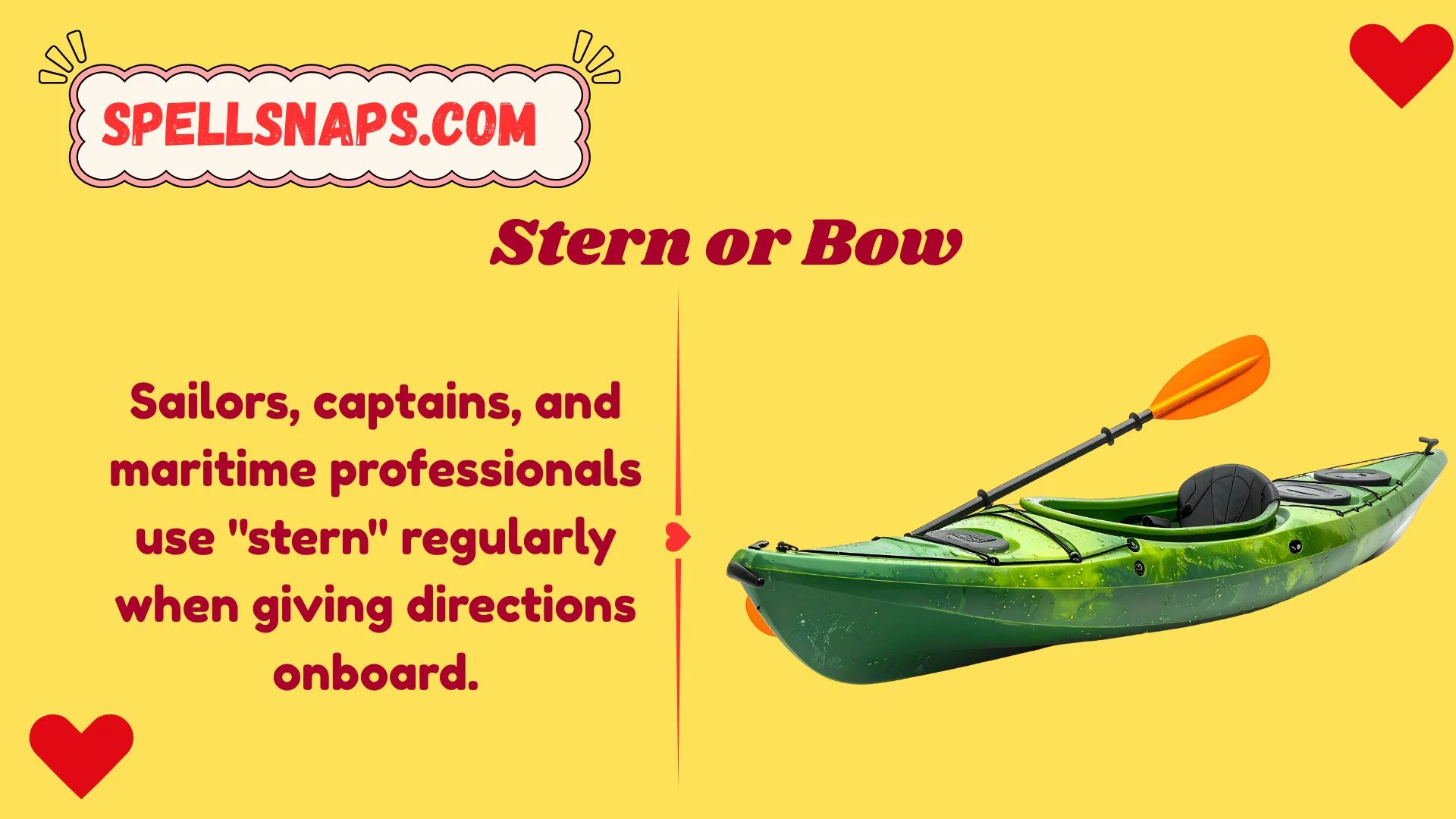
Sailors, captains, and maritime professionals use “stern” regularly when giving directions onboard.
Examples of Stern in Sentences
- The fishing equipment was stored near the stern of the boat.
- Passengers gathered at the stern to watch the sunset.
- The captain instructed the crew to secure the ropes at the stern.
- Waves crashed against the vessel’s stern during the storm.
Historical Note
The word stern comes from ancient Germanic and Old Norse roots associated with the back part of a vessel. Maritime cultures have used the term for centuries, making it one of the oldest navigational words still in use today.
Why Stern Matters
When comparing stern or bow, the stern plays a crucial role in steering, propulsion, and vessel control. Many modern boats position engines and navigation equipment near this section because it provides practical access to critical systems.
What Is “Bow”?
The bow is the front part of a boat or ship. It is the section that cuts through the water first as the vessel moves forward.
In discussions about stern or bow, the bow always refers to the forward-facing end of a vessel. It is specifically designed to reduce water resistance and improve navigation efficiency.
How Is Bow Used?
The term “bow” appears frequently in:
- Sailing instructions
- Maritime navigation
- Cruise ship operations
- Boating safety training
- Naval terminology
Crew members often receive directions based on the bow’s position because it determines the vessel’s forward orientation.
Examples of Bow in Sentences
- A lookout stood at the bow scanning the horizon.
- The passengers enjoyed the ocean view from the bow.
- The ship’s bow sliced smoothly through the waves.
- The anchor was lowered from the bow.
Regional and Usage Notes
Unlike many words that vary between American and British English, bow maintains the same meaning across major English-speaking regions when referring to a vessel’s front section.
However, pronunciation can sometimes confuse learners because “bow” has multiple meanings in English:
- Bow (boat front) = pronounced like “bough”
- Bow (ribbon knot) = pronounced “boh”
Context usually makes the intended meaning clear.
Why Bow Matters
When comparing stern or bow, the bow is vital because it determines the vessel’s forward direction, helps reduce drag, and often houses anchors, navigation lights, and lookout positions.
Key Differences Between Stern and Bow
Understanding the distinction between stern or bow becomes much easier when you compare them side by side.
Main Differences
- The stern is located at the back of a vessel.
- The bow is located at the front of a vessel.
- The bow leads movement through the water.
- The stern follows behind as the vessel moves.
- Anchors are commonly associated with the bow.
- Propulsion and steering systems are often associated with the stern.
- The bow faces the direction of travel.
- The stern faces the opposite direction.
Stern vs Bow Comparison Table
| Feature | Stern | Bow |
|---|---|---|
| Location | Back of the vessel | Front of the vessel |
| Direction | Rear-facing | Forward-facing |
| Primary Function | Steering and propulsion support | Navigation and water cutting |
| Position During Movement | Follows behind | Leads forward |
| Common Equipment | Engines, ladders, steering systems | Anchors, navigation lights |
| Passenger Experience | Wake viewing, boarding | Scenic forward views |
| Opposite Of | Bow | Stern |
| Maritime Importance | Vessel control | Vessel direction |
When discussing stern or bow, remembering “back versus front” is the simplest way to avoid mistakes.
Real-Life Conversation Examples
Dialogue 1
Emma: Let’s take pictures from the bow.
Jake: Isn’t the bow the back of the boat?
Emma: No, that’s the stern. The bow is at the front.
🎯 Lesson: The bow is always the front of the vessel, while the stern is the back.
Dialogue 2
Captain: Secure the lines at the stern.
New Crew Member: Should I go to the front?
Captain: No, the front is the bow. Head to the rear.
🎯 Lesson: Stern refers to the rear section of a boat.
Dialogue 3
Tourist: Why is everyone standing at the bow?
Guide: It offers the best view ahead of the ship.
Tourist: Oh, I thought that area was the stern.
🎯 Lesson: The bow faces forward and often provides panoramic views.
Dialogue 4
Friend 1: The engine seems noisy near the bow.
Friend 2: Most engines are actually closer to the stern.
🎯 Lesson: The stern commonly houses propulsion equipment.
Dialogue 5
Student: Which part of the ship hits the waves first?
Instructor: The bow does.
Student: So the stern comes afterward?
Instructor: Exactly.
🎯 Lesson: The bow leads the vessel through the water while the stern follows.
When to Use Stern vs Bow
Knowing when to use stern or bow correctly can make your communication much clearer, especially around experienced sailors and boating enthusiasts.
Use “Stern” When:
- Referring to the back of a boat
- Describing propulsion equipment
- Talking about the rear deck
- Giving navigation instructions involving the back section
Examples
- “Please move toward the stern.”
- “The life raft is stored near the stern.”
Use “Bow” When:
- Referring to the front of a vessel
- Discussing anchors
- Giving forward navigation directions
- Talking about the leading edge of a boat
Examples
- “Meet me at the bow.”
- “The anchor is attached near the bow.”
Easy Memory Tricks
Remember Stern = Rear
Both stern and rear contain strong, firm-sounding endings. Think of the stern as the vessel’s backside.
Remember Bow = Beginning
The bow is where the journey begins as the vessel moves forward.
Visual Trick
Imagine an arrow pointing forward:
- Arrow tip = Bow
- Arrow tail = Stern
This visual instantly helps distinguish stern or bow.
US vs UK Usage
There is no significant difference between American English and British English regarding these nautical terms.
Both countries use:
- Bow = front
- Stern = back
This consistency makes maritime communication easier internationally.
FAQs:
1. Ancient Ships Often Featured Decorative Bows
Many ancient civilizations decorated the bow of their vessels with carved animals, mythological creatures, or symbolic figures. These decorations were believed to offer protection and good fortune during voyages.
2. The Stern Once Represented Status
Historically, the stern of large sailing ships often featured elaborate designs, windows, and decorations. Wealthy shipowners used ornate stern structures to showcase prestige and power.
These traditions make the discussion of stern or bow more interesting because both parts of a vessel played important cultural and practical roles throughout maritime history.
Why Learning Stern and Bow Is Important
Many people think nautical terminology is only useful for sailors, but these words appear in:
- Cruise travel
- Maritime news
- Boating courses
- Adventure tourism
- Historical documentaries
- Naval discussions
Understanding stern or bow helps you follow instructions accurately and communicate confidently around boats and ships.
For example, if a safety announcement directs passengers toward the bow or stern during an emergency, knowing the difference becomes extremely important.
Common Mistakes People Make
Here are some frequent errors:
Mistake 1: Thinking Stern Means Front
Many beginners assume stern refers to the front because the word sounds formal and authoritative.
Mistake 2: Mixing Up Directions
People often forget which side leads movement through the water.
Mistake 3: Using Them Interchangeably
Since both terms describe parts of a vessel, some speakers mistakenly swap them.
The easiest solution is remembering:
Bow = Front
Stern = Back
This simple rule eliminates nearly all confusion.
Conclusion
Understanding the difference between stern or bow is surprisingly simple once you know where each part of a vessel is located.
The bow refers to the front of a boat or ship and leads the way through the water, while the stern refers to the rear and often contains steering and propulsion equipment.
Whether you’re reading about maritime history, taking a sailing lesson, or enjoying a cruise, knowing these terms helps you communicate more accurately and understand nautical directions with confidence.
Next time someone uses these two words, you’ll know exactly what they mean!

I am a passionate writer and content creator with a strong interest in English grammar, language learning, and effective communication. I enjoy helping readers improve their writing skills through clear, practical, and easy-to-understand content. My goal is to make grammar concepts simple and accessible for learners of all levels. Through my articles, I share useful tips, explanations, and insights that help readers gain confidence in their English language journey. I am committed to providing accurate, engaging, and valuable information that supports continuous learning and personal growth.