
Planning a trip to Utah often leads to one big question: Bryce or Zion? Both parks rank among the most breathtaking natural destinations in the United States, attracting millions of visitors every year. Yet many travelers struggle to decide which one deserves a spot on their itinerary.
The confusion is understandable. Both parks feature stunning red-rock landscapes, unforgettable hiking trails, dramatic viewpoints, and incredible opportunities for photography. However, each park offers a completely different experience.
Although they look similar, they serve completely different purposes. Zion is known for towering canyon walls and adventurous hikes, while Bryce stands out for its unique hoodoo rock formations and panoramic vistas.
In this guide, you’ll discover the key differences between Bryce or Zion, helping you choose the destination that best matches your travel style, interests, and adventure goals.
What Is Bryce?
When people discuss Bryce or Zion, Bryce usually refers to Bryce Canyon National Park, located in southern Utah.
Despite its name, Bryce Canyon is not technically a canyon. Instead, it is a massive natural amphitheater filled with thousands of colorful rock spires known as hoodoos. These formations were created through millions of years of erosion and weathering.
How Bryce Is Used
Bryce is often chosen by travelers who enjoy:
- Scenic viewpoints
- Photography
- Easy-to-moderate hiking
- Stargazing
- Peaceful outdoor experiences
Many visitors prefer Bryce because the park’s major attractions are easily accessible from scenic overlooks.
Where Bryce Is Located
Bryce Canyon National Park sits in southwestern Utah at an elevation of approximately 8,000–9,000 feet. The higher elevation means cooler temperatures throughout much of the year.
Popular Attractions in Bryce
Some of the park’s most famous spots include:
- Sunrise Point
- Sunset Point
- Bryce Amphitheater
- Inspiration Point
- Navajo Loop Trail
- Queen’s Garden Trail
Example Sentences
- “We chose Bryce because we wanted amazing sunrise photographs.”
- “The hoodoos in Bryce looked like something from another planet.”
- “Bryce offered cooler weather during our summer trip.”
Historical Note
Bryce Canyon received national park status in 1928. The park was named after Ebenezer Bryce, a pioneer who settled nearby during the late nineteenth century.
For travelers comparing Bryce or Zion, Bryce often wins when scenery and photography are the main priorities.
What Is Zion?
The second half of the Bryce or Zion debate focuses on Zion National Park, another world-famous destination in southern Utah.
Zion is known for its massive sandstone cliffs, deep canyons, and thrilling outdoor adventures. Unlike Bryce’s elevated viewpoints, Zion immerses visitors directly within towering canyon walls.
How Zion Is Used
Travelers often choose Zion for:
- Challenging hikes
- Adventure travel
- Rock climbing
- River exploration
- Canyon experiences
Many outdoor enthusiasts consider Zion one of the best hiking destinations in North America.
Where Zion Is Located
Zion National Park lies in southwestern Utah near Springdale. Its lower elevation generally results in warmer temperatures compared to Bryce.
Popular Attractions in Zion
Top highlights include:
- Angels Landing
- The Narrows
- Zion Canyon Scenic Drive
- Emerald Pools
- Observation Point
- Canyon Overlook Trail
Example Sentences
- “We picked Zion because we wanted more adventurous hikes.”
- “Walking through The Narrows was unforgettable.”
- “Zion’s canyon walls made us feel incredibly small.”
Historical Note
Zion became a national park in 1919. The name “Zion” has historical roots associated with a place of refuge or sanctuary.
When evaluating Bryce or Zion, Zion usually appeals to travelers seeking excitement and physical challenges.
Key Differences Between Bryce and Zion
Understanding the differences between Bryce or Zion can make your decision much easier.
Quick Differences
- Bryce is famous for hoodoos.
- Zion is famous for canyons.
- Bryce offers cooler temperatures.
- Zion offers more adventure-focused hiking.
- Bryce provides easier sightseeing.
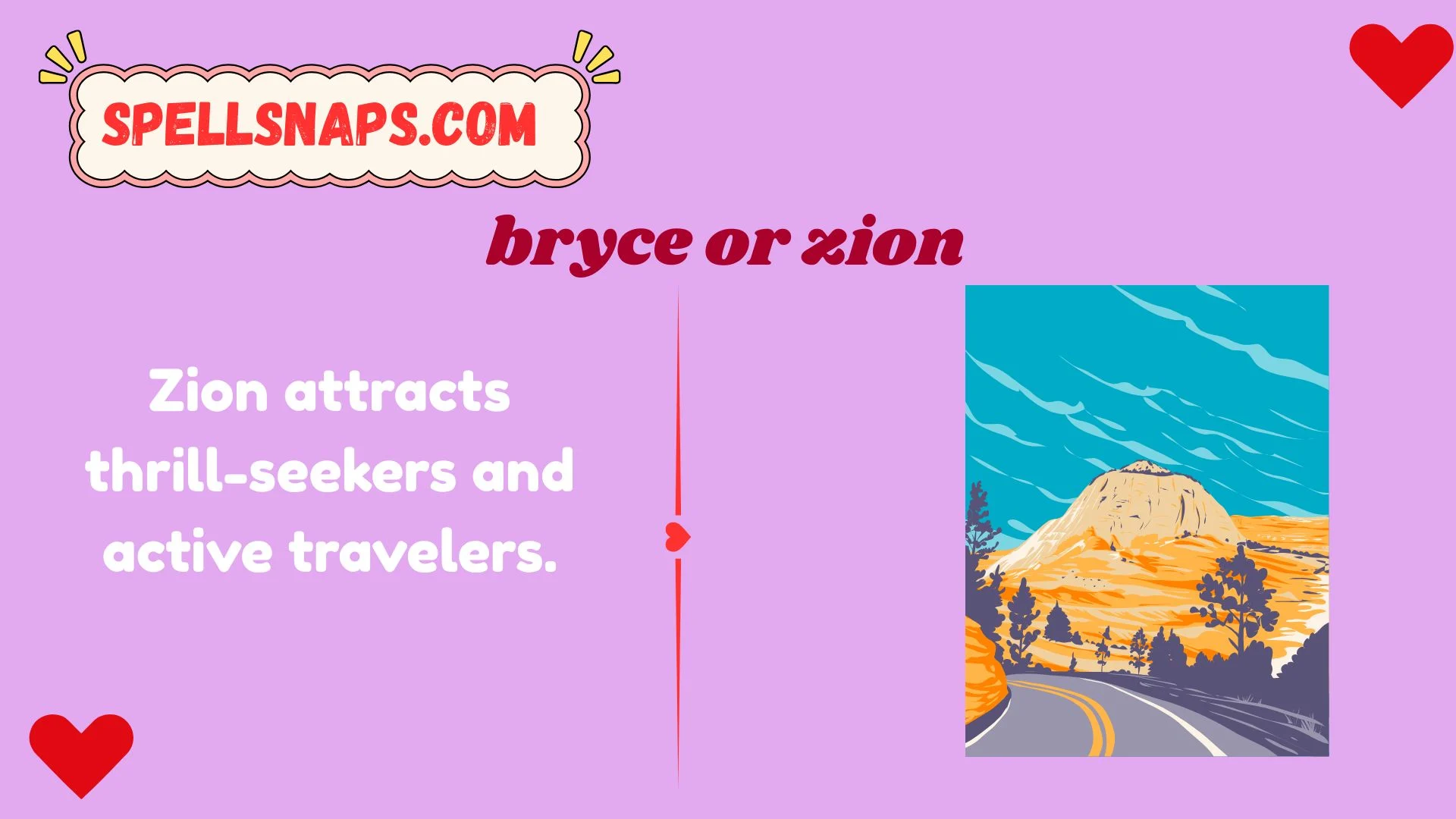
- Zion attracts thrill-seekers and active travelers.
- Bryce typically feels quieter.
- Zion often experiences larger crowds.
Comparison Table
| Feature | Bryce Canyon National Park | Zion National Park |
|---|---|---|
| Main Attraction | Hoodoos and amphitheaters | Massive canyon walls |
| Elevation | Higher | Lower |
| Weather | Cooler | Warmer |
| Best For | Photography and viewpoints | Adventure and hiking |
| Hiking Difficulty | Easy to moderate | Moderate to strenuous |
| Crowds | Generally lighter | Often heavier |
| Scenic Style | Open panoramic views | Immersive canyon scenery |
| Stargazing | Excellent | Very good |
| Family Friendliness | High | High |
| Adventure Level | Moderate | High |
Real-Life Conversation Examples
Dialogue 1
Sarah: “Should we visit Bryce or Zion this weekend?”
Mark: “Do you want scenic overlooks or adventurous hikes?”
Sarah: “Definitely scenic overlooks.”
Mark: “Then Bryce sounds perfect.”
🎯 Lesson: Choose Bryce if you prefer easy access to breathtaking views.
Dialogue 2
David: “I’ve always wanted to hike Angels Landing.”
Emma: “That’s in Zion, not Bryce.”
David: “Then Zion is at the top of my list.”
🎯 Lesson: Zion is ideal for travelers seeking challenging adventures.
Dialogue 3
Chris: “Which park has those strange rock towers?”
Taylor: “You’re thinking about Bryce.”
Chris: “That’s exactly what I wanted to see.”
🎯 Lesson: Hoodoos are Bryce’s signature attraction.
Dialogue 4
Rachel: “It’s supposed to be very hot this weekend.”
Ben: “Bryce might feel more comfortable because of the higher elevation.”
Rachel: “Good point.”
🎯 Lesson: Bryce often offers cooler temperatures than Zion.
Dialogue 5
Jason: “We only have one day. Bryce or Zion?”
Mia: “If you want a relaxed sightseeing day, choose Bryce.”
Jason: “That sounds perfect.”
🎯 Lesson: Bryce is often easier to explore in a limited amount of time.
When to Use Bryce vs Zion
If you’re still deciding between Bryce or Zion, these simple guidelines can help.
Choose Bryce If:
- You love photography.
- You want spectacular viewpoints.
- You prefer easier hikes.
- You enjoy cooler weather.
- You have limited time.
Choose Zion If:
- You enjoy physical challenges.
- You want iconic hikes.
- You love canyon landscapes.
- You seek adventure.
- You don’t mind larger crowds.
Simple Memory Tricks
Bryce = Beauty
Think of Bryce as the park for scenic beauty, viewpoints, and photography.
Zion = Zoom
Think of Zion as the park where you’ll be moving, hiking, climbing, and exploring.
For International Travelers
Whether you’re visiting from the United States, the United Kingdom, Canada, Australia, or elsewhere, the comparison remains the same. The choice depends more on your travel preferences than your location.
Fun Facts and History
Bryce Fact
Bryce Canyon contains thousands of hoodoos, making it one of the largest concentrations of these unique rock formations anywhere on Earth.
Zion Fact
Some of Zion’s sandstone cliffs rise more than 2,000 feet above the canyon floor, creating one of the most dramatic landscapes in the American Southwest.
Conclusion:
The Bryce or Zion decision ultimately comes down to the type of experience you want. Bryce Canyon National Park shines with its extraordinary hoodoos, panoramic viewpoints, cooler climate, and photography opportunities. Zion National Park, on the other hand, delivers thrilling hikes, towering canyon walls, and unforgettable adventures.
Neither choice is wrong because both parks showcase some of the most spectacular scenery in the United States. If possible, visit both and experience their unique beauty firsthand. But if you must choose one, let your travel style guide the decision.
Next time someone asks Bryce or Zion, you’ll know exactly which park fits their adventure best!

I am a passionate writer and content creator with a strong interest in English grammar, language learning, and effective communication. I enjoy helping readers improve their writing skills through clear, practical, and easy-to-understand content. My goal is to make grammar concepts simple and accessible for learners of all levels. Through my articles, I share useful tips, explanations, and insights that help readers gain confidence in their English language journey. I am committed to providing accurate, engaging, and valuable information that supports continuous learning and personal growth.