Have you ever stopped while writing because you weren’t sure whether to use incompass or encompass? You’re not alone.
Many writers, students, and even professionals search for incompass or encompass because the two words look almost identical. At first glance, it’s easy to assume they’re simply different spellings of the same word.
Although they look similar, they serve completely different purposes.
The truth is that one is a standard English word you’ll find in dictionaries and professional writing, while the other is generally considered a spelling mistake.
Understanding the difference will help you write with greater confidence, avoid embarrassing errors, and communicate more clearly.
In this guide, you’ll learn exactly what each term means, when to use it, common examples, memory tricks, and the key differences between incompass or encompass in everyday English.
What Is “Incompass”?
When discussing incompass or encompass, it’s important to start with the word that causes the confusion.
Simply put, incompass is not a standard English word. Modern dictionaries do not recognize it as the correct spelling in contemporary English. In almost every situation, if you write incompass, you actually mean encompass.
Many people accidentally type incompass because:
- The prefix “in-“ is common in English.
- The words sound similar when spoken quickly.
- Spell-check may not immediately catch the mistake in some situations.
- Writers assume both spellings are acceptable.
How Is It Used?
In modern English, incompass should generally not be used.
If you see it online, it is usually:
- A typo
- A misspelling
- An outdated or historical spelling found in very old texts
When comparing incompass or encompass, remember that professional editors, teachers, publishers, and style guides overwhelmingly recommend using encompass.
Where Is It Used?
There is no difference between American English and British English regarding this spelling.
Both varieties of English recognize encompass as the correct spelling.
Examples
Incorrect:
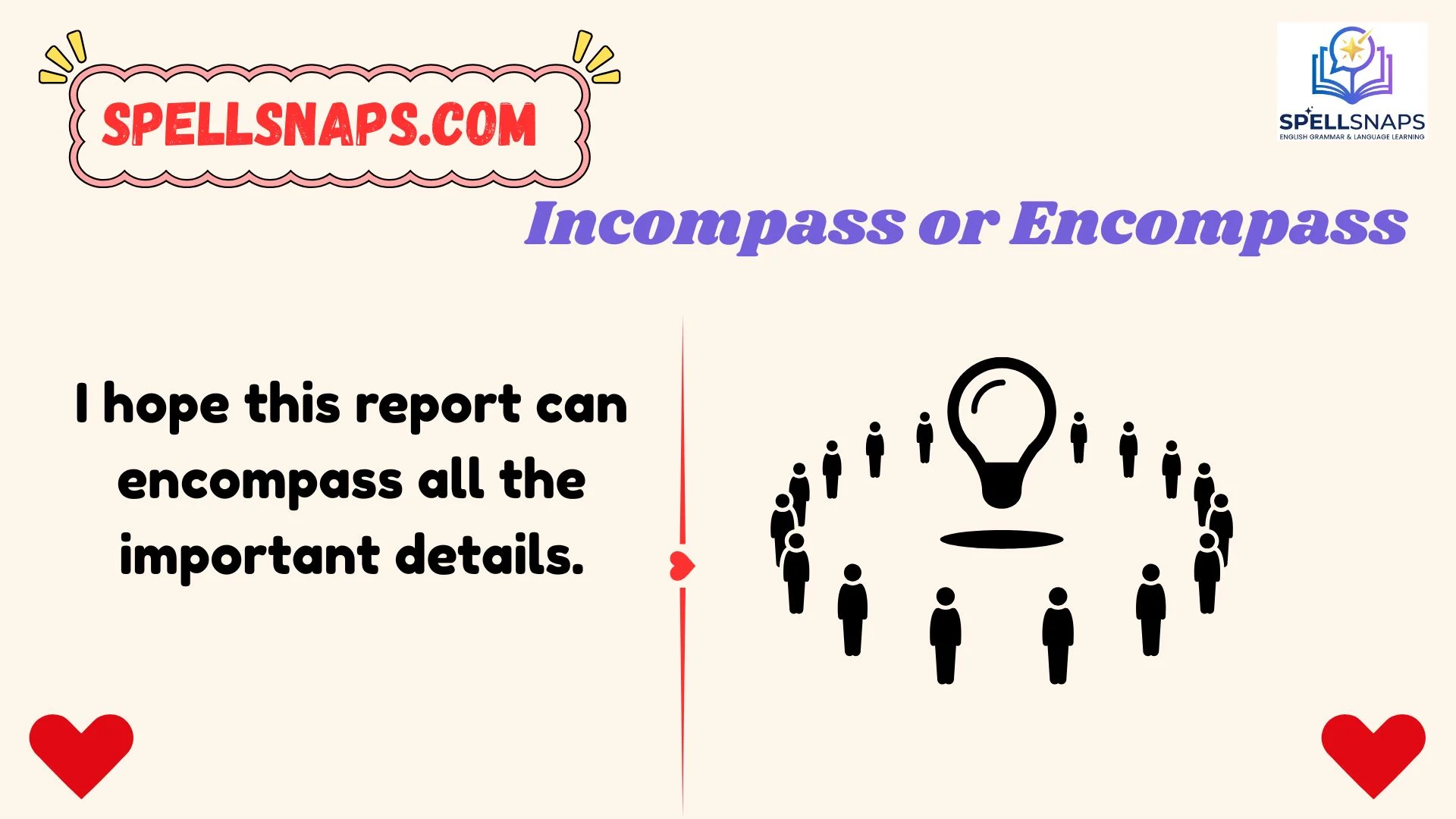
- I hope this report can incompass all the important details.
- Our services incompass many industries.
- The project will incompass every department.
Correct versions:
- I hope this report can encompass all the important details.
- Our services encompass many industries.
- The project will encompass every department.
Historical Usage
Centuries ago, some historical documents contained spellings that resemble incompass, but English spelling was far less standardized than it is today. Modern dictionaries and style guides no longer recognize it as standard usage.
Whenever you’re deciding between incompass or encompass, choose encompass.
What Is “Encompass”?
The second half of incompass or encompass is the correct and widely accepted English word.
Encompass is a verb that means:
- to include completely
- to surround
- to contain
- to cover a wide range of things
It is commonly used in academic writing, journalism, business communication, technical documents, and everyday conversations.
How Is It Used?
You use encompass whenever something includes many parts or completely surrounds something else.
It often appears with words such as:
- ideas
- services
- responsibilities
- topics
- skills
- areas
- regions
- knowledge
Examples
- Our training program encompasses leadership, communication, and technical skills.
- The national park encompasses several forests and lakes.
- Her responsibilities encompass hiring, budgeting, and project management.
- This guide encompasses everything beginners need to know.
- The company’s vision encompasses innovation and sustainability.
Grammar Notes
Encompass is a regular verb.
Examples:
- encompass
- encompasses
- encompassed
- encompassing
All of these forms are correct.
Regional Usage
Whether you’re writing for the United States, the United Kingdom, Canada, Australia, or other English-speaking countries, encompass remains the standard spelling.
There is no regional spelling difference when comparing incompass or encompass.
Key Differences Between Incompass and Encompass
Understanding incompass or encompass becomes much easier when you compare them side by side.
Quick Differences
- Encompass is the correct English verb.
- Incompass is considered a misspelling in modern English.
- Encompass appears in dictionaries.
- Incompass should generally be avoided.
- Professional writers always use encompass.
- Both American and British English prefer encompass.
Comparison Table
| Feature | Incompass | Encompass |
|---|---|---|
| Dictionary word | ❌ No | ✅ Yes |
| Correct modern spelling | ❌ No | ✅ Yes |
| Part of speech | Not standard | Verb |
| Means “include completely” | ❌ No | ✅ Yes |
| Means “surround” | ❌ No | ✅ Yes |
| Accepted in US English | ❌ No | ✅ Yes |
| Accepted in UK English | ❌ No | ✅ Yes |
| Recommended for professional writing | ❌ Never | ✅ Always |
Real-Life Conversation Examples
Dialogue 1
Emma: Does this report incompass all the sales figures?
David: I think you mean encompass.
Emma: Thanks! I’ll correct it.
🎯 Lesson: Encompass is the correct spelling when something includes everything.
Dialogue 2
Teacher: Which word should you use here?
Student: I wrote incompass.
Teacher: Replace it with encompass because that’s the standard English spelling.
🎯 Lesson: Modern English dictionaries recognize encompass, not incompass.
Dialogue 3
Manager: Our services encompass consulting, design, and support.
Employee: I almost wrote incompass.
Manager: Spell-check is helpful, but knowing the correct word is even better.
🎯 Lesson: Use encompass whenever something covers multiple areas.
Dialogue 4
Friend: Why does my grammar checker underline incompass?
Friend 2: Because the correct word is encompass.
🎯 Lesson: Grammar tools usually flag incompass as an error.
Dialogue 5
Writer: Should I use incompass or encompass in my article?
Editor: Definitely encompass.
🎯 Lesson: Professional editors always recommend encompass.
When to Use Incompass vs Encompass
Choosing between incompass or encompass is actually very simple.
Use Encompass When:
- something includes many things
- something surrounds another thing
- writing professionally
- writing academically
- writing emails
- creating reports
- publishing online
- writing books
Avoid Incompass
There is almost no situation in modern English where incompass is the preferred choice.
If you accidentally type it, replace it with encompass.
Easy Memory Trick
Think of the word enclose.
Both enclose and encompass begin with “en-“, and both relate to the idea of surrounding or including.
That simple connection makes remembering encompass much easier.
Another trick:
Encompass = Entirely Includes
Both words begin with En.
US vs UK English
When comparing incompass or encompass, there is no spelling difference between American and British English.
| English Variety | Preferred Spelling |
| American English | Encompass |
| British English | Encompass |
| Canadian English | Encompass |
| Australian English | Encompass |
No major English style guide recommends incompass.
Fun Facts and History
1. The Origin of “Encompass”
The word encompass comes from Middle English and developed from the idea of forming a circle around something. Over time, its meaning expanded to include covering, including, and embracing a broad range of subjects.
2. Why People Still Search for “Incompass”
Search engines receive thousands of queries for incompass or encompass because pronunciation makes the words sound similar. Many people hear the word before they ever see it written, leading to a natural spelling mistake. This makes it one of the more common English spelling confusions.
Common Mistakes to Avoid
Here are a few mistakes writers frequently make when deciding between incompass or encompass:
- ❌ Our policy incompasses every situation.
- ✅ Our policy encompasses every situation.
- ❌ The museum incompassed local history.
- ✅ The museum encompassed local history.
- ❌ This course will incompass grammar and vocabulary.
- ✅ This course will encompass grammar and vocabulary.
A quick proofreading pass can prevent these errors before publishing.
FAQs:
Is “incompass” a real word?
In modern English, no. It is generally treated as a misspelling of encompass.
Is “encompass” correct?
Yes. Encompass is the correct verb used to describe including, surrounding, or covering something completely.
Is there a British spelling of “encompass”?
No. Both British and American English use encompass.
Why do people confuse “incompass” and “encompass”?
Because they sound similar, share many of the same letters, and English prefixes like in- and en- can easily be mixed up during spelling.
Conclusion:
Understanding the difference between incompass or encompass is much easier than it first appears.
While the two words look remarkably similar, only encompass is accepted in modern English.
It means to include, contain, or surround completely, making it the right choice for academic, professional, and everyday writing. On the other hand, incompass is generally considered a spelling mistake and should be avoided.
By remembering a few simple usage rules and proofreading carefully, you’ll write with greater confidence and accuracy. Next time someone uses these two words, you’ll know exactly what they mean!

I am a passionate writer and content creator with a strong interest in English grammar, language learning, and effective communication. I enjoy helping readers improve their writing skills through clear, practical, and easy-to-understand content. My goal is to make grammar concepts simple and accessible for learners of all levels. Through my articles, I share useful tips, explanations, and insights that help readers gain confidence in their English language journey. I am committed to providing accurate, engaging, and valuable information that supports continuous learning and personal growth.