
Have you ever wondered whether you should say fracture or break? You’re not alone. These two words are often used interchangeably, especially when talking about bones, damaged objects, or injuries.
Because they frequently appear in everyday conversations, medical discussions, sports reports, and news articles, many people assume they have exactly the same meaning.
The truth is that while they are closely related, fracture and break are not always used in the same way. The context often determines which word sounds more natural or more accurate.
Although they look/sound similar, they serve completely different purposes.
In this guide, you’ll learn the meaning of fracture or break, where each word is commonly used, how professionals use them, and the easiest way to remember the difference. By the end, you’ll know exactly when to choose the right word with confidence.
What Is “Fracture”?
A fracture is a crack, split, or complete separation in something that is normally solid. While the word can describe damage to many materials, it is most commonly used in medical, scientific, and engineering contexts.
In healthcare, a fracture refers to any type of broken bone. Contrary to popular belief, doctors do not distinguish between a “fracture” and a “broken bone” they mean the same injury. Medical professionals simply prefer the more technical term fracture because it covers every type of bone damage, from tiny hairline cracks to complete breaks.
Outside medicine, the word also appears in geology, construction, engineering, and materials science. Rocks can develop fractures, glass may fracture under pressure, and metal components may fracture after repeated stress.
Common Uses of Fracture
- Medical reports
- Hospital records
- X-ray results
- Engineering documents
- Geological studies
- Scientific research
Examples
- The X-ray confirmed a fracture in her wrist.
- The athlete suffered a small fracture during the match.
- Years of pressure caused a fracture in the rock formation.
- Engineers inspected the bridge for structural fractures.
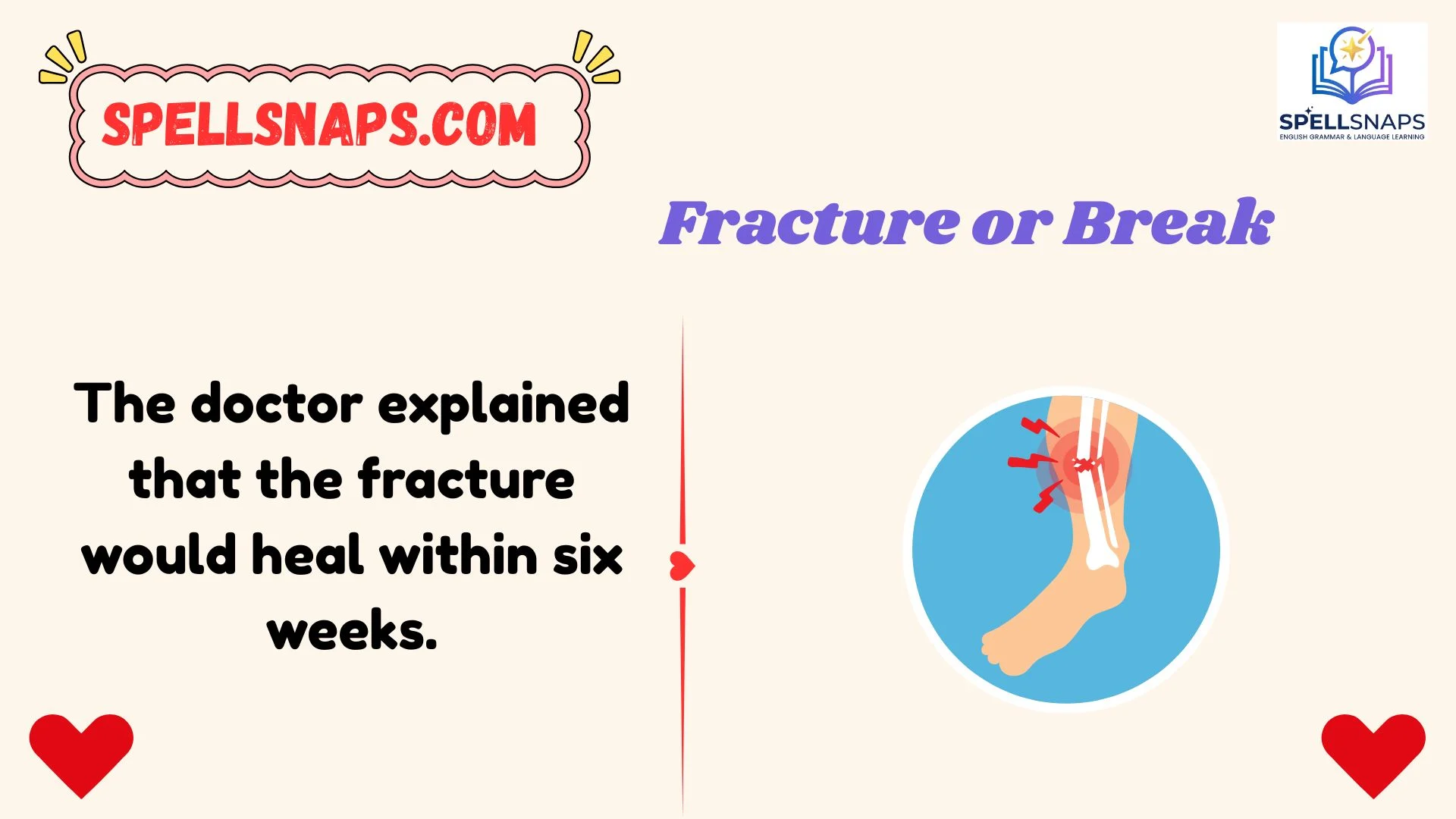
- The doctor explained that the fracture would heal within six weeks.
Historical Usage
The word fracture comes from the Latin fractura, meaning “a breaking.” It entered English centuries ago and has remained the preferred technical term in medicine and science because of its precision. Today, healthcare professionals around the world continue using fracture in diagnoses, research papers, and medical textbooks.
What Is “Break”?
A break is a much broader and more flexible English word. It generally means to separate, damage, crack, interrupt, or stop something. Unlike fracture, it is widely used in everyday speech and applies to countless situations.
When someone says they “broke a bone,” they are describing exactly the same injury that doctors call a fracture. However, the word break also describes broken phones, broken promises, broken relationships, broken windows, broken machines, and even taking a break from work.
Because of its versatility, break is one of the most commonly used verbs and nouns in English.
Common Uses of Break
- Everyday conversation
- Informal writing
- News reports
- General descriptions
- Objects and materials
- Relationships and routines
Examples
- I accidentally broke my phone.
- He broke his arm while skiing.
- Please don’t break the glass.
- We need a short break before continuing.
- The company decided to break the contract.
Usage Notes
Unlike fracture, the word break works in both literal and figurative situations. You can break a bone, a chair, a promise, a record, a habit, or even silence.
In medical conversations with friends and family, saying someone has a broken leg sounds perfectly natural. Doctors, however, are more likely to write leg fracture in official documentation.
Key Differences Between Fracture and Break
Although fracture or break often describe the same physical injury, they differ mainly in tone, precision, and context.
Main Differences
- Fracture is more technical and formal.
- Break is common in everyday English.
- Doctors usually write fracture in medical records.
- Most people say broken bone in conversation.
- Break has many figurative meanings.
- Fracture is mostly limited to physical damage.
- Engineers and scientists often prefer fracture.
- Casual speakers usually prefer break.
Comparison Table
| Feature | Fracture | Break |
|---|---|---|
| Meaning | Crack or separation, especially in bones | Damage or separation of something |
| Tone | Formal, technical | Informal and everyday |
| Medical Use | Preferred by healthcare professionals | Common in daily conversation |
| Scientific Use | Very common | Less common |
| Figurative Meaning | Rare | Very common |
| Used for Bones | Yes | Yes |
| Used for Objects | Sometimes | Very often |
| Common in Conversation | Less common | Extremely common |
Real-Life Conversation Examples
Dialogue 1
Emma: Did you hear Jake hurt his ankle?
Liam: Yes, the doctor said it’s a fracture.
Emma: Oh, so he actually broke his ankle?
Liam: Exactly—they mean the same thing.
🎯 Lesson: Doctors usually say fracture, while most people say break.
Dialogue 2
Teacher: Why are you absent from football practice?
Student: I broke my wrist.
Teacher: I’m sorry to hear that.
Student: The hospital report says it’s a wrist fracture.
🎯 Lesson: Medical reports often use fracture, while casual speech uses break.
Dialogue 3
Dad: Who broke the window?
Son: It wasn’t me!
Dad: Good thing nobody got hurt.
🎯 Lesson: Break is the natural choice for damaged everyday objects.
Dialogue 4
Engineer: The inspection found a structural fracture.
Manager: Should we replace the beam immediately?
Engineer: Yes, before it becomes dangerous.
🎯 Lesson: Technical professions often choose fracture because it sounds more precise.
Dialogue 5
Sarah: I need a break from work.
Mark: You’ve been working nonstop.
Sarah: Just ten minutes will help.
🎯 Lesson: Only break has figurative meanings like resting or pausing.
When to Use Fracture vs Break
Choosing between fracture or break becomes easy once you know your audience and purpose.
Use Fracture When:
- Writing medical content
- Reading X-ray reports
- Creating scientific documents
- Discussing engineering or geology
- Using formal or technical language
Use Break When:
- Talking with friends
- Writing everyday English
- Describing damaged objects
- Speaking naturally
- Using figurative expressions
Simple Memory Tricks
- Fracture = Formal
- Break = Basic everyday English
- Doctors diagnose fractures.
- Families usually talk about broken bones.
- If you’re unsure in casual conversation, break is usually the safer choice.
US vs UK English
Unlike many English word pairs, fracture and break are used the same way in both American and British English.
Doctors in the United States and the United Kingdom both use fracture in professional medical settings.
People in both countries commonly say I broke my arm rather than I fractured my arm during everyday conversations.
The difference is based on formality, not regional spelling or grammar.
Fun Facts and History
1. A Broken Bone Is Always a Fracture
One of the biggest misconceptions is that a fracture is less serious than a break. This is completely false.
Medical professionals consider every broken bone to be a fracture, whether it’s a tiny hairline crack or a severe injury where the bone separates completely.
2. There Are Many Types of Fractures
Doctors classify fractures into several categories, including:
- Hairline fracture
- Stress fracture
- Greenstick fracture
- Spiral fracture
- Compound (open) fracture
- Compression fracture
Although these injuries differ in severity and appearance, each one is still a broken bone.
Common Mistakes to Avoid
Many learners make small mistakes when comparing fracture or break. Avoid these common errors:
- Thinking a fracture is less serious than a break.
- Saying only doctors can use the word fracture.
- Using fracture for figurative expressions like “fractured a promise.”
- Assuming break is incorrect in medical conversations.
- Believing American and British English use different meanings.
Remember, context—not correctness—usually determines which word sounds best.
FAQs:
Is a fracture the same as a break?
Yes. In medicine, fracture and break refer to the same bone injury. The difference is that fracture is the technical term, while break is the everyday expression.
Which word is more formal?
Fracture is significantly more formal and is commonly used by healthcare professionals, researchers, and engineers.
Can I say “broken bone” instead of “fractured bone”?
Absolutely. Both expressions are correct. Broken bone is more common in everyday conversation.
Is fracture only used for bones?
No. A fracture can also describe cracks in rocks, metal, glass, concrete, and other solid materials.
Can break be used figuratively?
Yes. You can break a promise, break the rules, break the silence, or take a break. Fracture is rarely used this way.
Conclusion:
Understanding the difference between fracture or break is much easier once you recognize the context.
Fracture is the precise, technical term used in medicine, engineering, and science, while break is the everyday word people naturally use in conversations.
When discussing bone injuries, both words often describe the same condition, but their tone and audience differ.
Knowing when to choose each word will make your writing and speaking sound more accurate and natural.
Whether you’re reading a medical report or chatting with friends, you’ll now understand the distinction with confidence. Next time someone uses these two words, you’ll know exactly what they mean!

I am a passionate writer and content creator with a strong interest in English grammar, language learning, and effective communication. I enjoy helping readers improve their writing skills through clear, practical, and easy-to-understand content. My goal is to make grammar concepts simple and accessible for learners of all levels. Through my articles, I share useful tips, explanations, and insights that help readers gain confidence in their English language journey. I am committed to providing accurate, engaging, and valuable information that supports continuous learning and personal growth.