
Have you ever seen the words kite and Kyte and wondered if they mean the same thing? You’re not alone.
Many people search for kite or Kyte because the two words look almost identical and sound exactly alike.
At first glance, it’s easy to assume that one is simply an alternative spelling of the other. However, that isn’t the case.
Although they look similar, they serve completely different purposes. One is a common English word that most people learn as children, while the other is usually a surname, a brand name, or a proper noun.
Knowing the difference is important whether you’re writing an article, sending an email, working on a school assignment, or creating professional content.
In this guide, you’ll learn exactly what kite and Kyte mean, where each is used, practical examples, and simple tricks to help you remember the correct choice every time.
What Is Kite?
The word kite is a common English noun with several meanings depending on the context. Its most familiar meaning is the lightweight object made from paper, plastic, or fabric that flies in the air while attached to a string. People often fly a kite on windy days for recreation or during festivals.
Another meaning of kite refers to a bird of prey known for its graceful flight and sharp eyesight. Several species of kites live across Europe, Asia, Africa, and the Americas.
In business and finance, the word kite has historically been used in expressions such as check kiting, although this usage is much less common in everyday writing.
Where Is “Kite” Used?
The spelling kite is considered the standard form in:
- American English
- British English
- Canadian English
- Australian English
- Other English-speaking countries
There are no regional spelling differences for this word. Whether you’re writing for a US or UK audience, kite remains the correct spelling.
Examples of “Kite” in Sentences
- The children flew a kite at the beach all afternoon.
- My colorful kite reached higher than everyone else’s.
- We watched a red kite circle above the countryside.
- She bought a new kite before the spring festival.
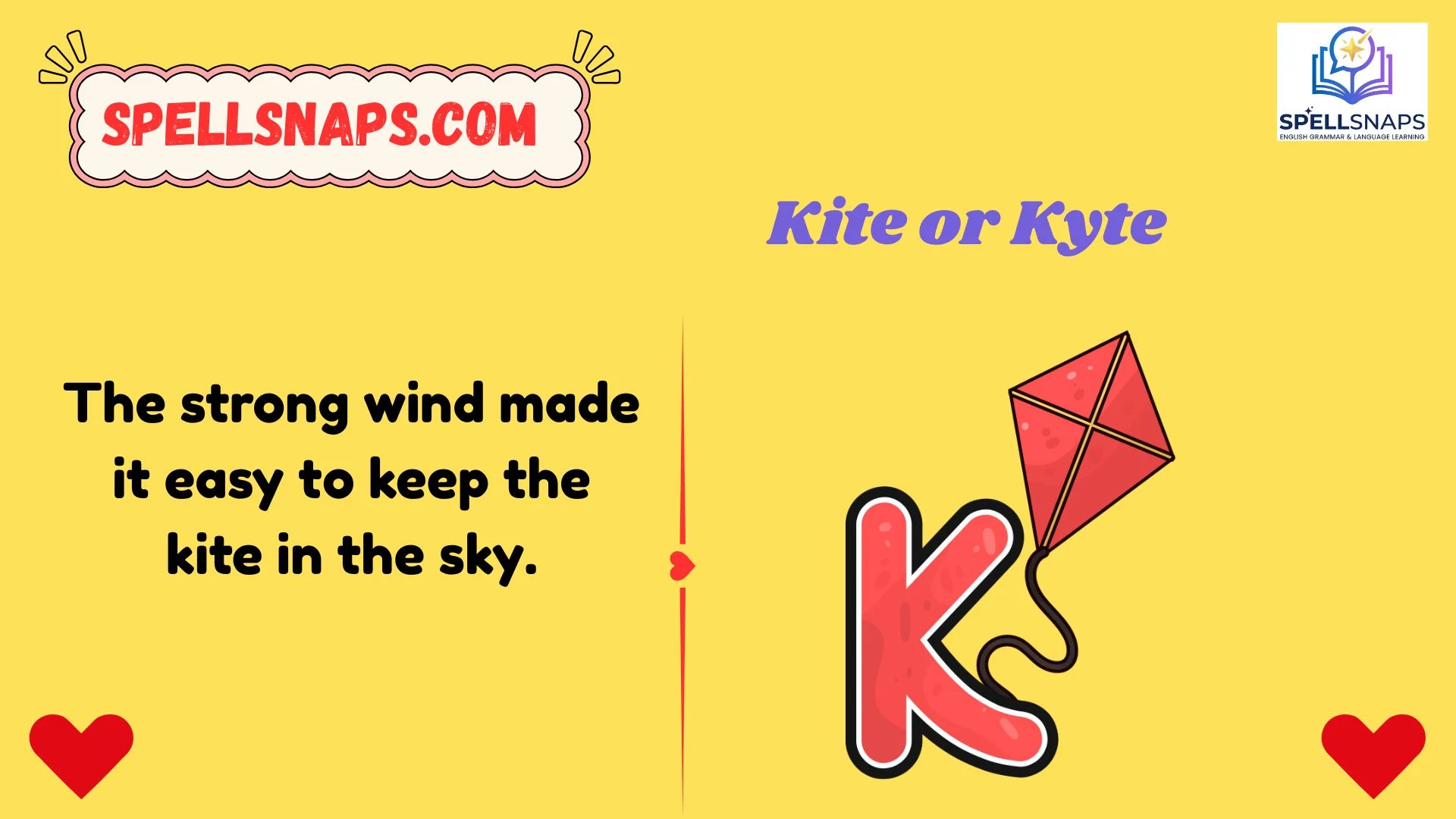
- The strong wind made it easy to keep the kite in the sky.
Historical Note
The kite has existed for more than 2,000 years. Historians generally believe that the earliest kites were developed in ancient China before spreading throughout Asia and eventually reaching Europe. Over time, kites have been used not only for entertainment but also for scientific experiments, military observation, weather research, and education.
What Is Kyte?
Unlike kite, Kyte is not a standard English dictionary word. Instead, Kyte is most commonly used as a proper noun, which means it functions as a name rather than a regular vocabulary word.
You may encounter Kyte in several ways:
- As a surname
- As a first name in some cases
- As the name of a company or brand
- As a product or business name
Because Kyte is a proper noun, it is usually capitalized.
Where Is “Kyte” Used?
You’ll typically find Kyte in:
- Personal names
- Business names
- Technology companies
- Brand identities
- Corporate documents
Unlike kite, Kyte is not used to describe an object or animal.
Examples of “Kyte” in Sentences
- Sarah Kyte spoke at the conference yesterday.
- We rented a vehicle through Kyte.
- Professor Kyte published a new research paper.
- The company Kyte launched another service this year.
- Mr. Kyte answered all of our questions.
Usage Note
Many businesses intentionally choose unique spellings like Kyte because distinctive names are easier to trademark, remember, and find online. This modern branding strategy helps companies stand out from competitors while maintaining an easy-to-pronounce name.
Key Differences Between Kite and Kyte
Although kite and Kyte sound identical, they belong to completely different categories of English.
Quick Differences
- Kite is a common English word.
- Kyte is generally a proper noun.
- Kite refers to an object, a bird, or certain financial terms.
- Kyte usually identifies a person, company, or brand.
- Kite appears in dictionaries.
- Kyte usually appears in names rather than vocabulary lists.
- Kite is not normally capitalized unless it starts a sentence.
- Kyte is usually capitalized because it is a name.
| Feature | Kite | Kyte |
|---|---|---|
| Word Type | Common noun | Proper noun |
| Dictionary Word | Yes | Usually no |
| Main Meaning | Flying toy, bird, financial term | Name, surname, or brand |
| Capitalization | Usually lowercase | Usually capitalized |
| Used in Everyday English | Yes | Only when referring to specific names |
| US English | Standard spelling | Proper names only |
| UK English | Standard spelling | Proper names only |
| Grammar Role | Regular vocabulary | Name or title |
Real-Life Conversation Examples
Dialogue 1
Emma: Did you buy a new Kyte for the festival?
Noah: Do you mean a kite? The one that flies in the sky?
Emma: Oh yes! I mixed up the spelling.
🎯 Lesson: Use kite when talking about the flying object.
Dialogue 2
James: I booked my rental through Kyte.
Olivia: I thought you said kite.
James: No, Kyte is the company’s name.
🎯 Lesson: Kyte often refers to a business or brand.
Dialogue 3
Teacher: Can someone spell the word?
Student: K-Y-T-E?
Teacher: That’s a name. The correct spelling is K-I-T-E.
🎯 Lesson: The common English word is always kite.
Dialogue 4
David: Professor Kyte will give today’s lecture.
Anna: I almost thought you meant the bird!
🎯 Lesson: Capital letters usually signal that Kyte is a person’s name.
Dialogue 5
Liam: I saw a beautiful kite flying overhead.
Sophia: Was it the toy or the bird?
Liam: The bird!
🎯 Lesson: Context tells you which meaning of kite is intended.
When to Use Kite vs Kyte
Choosing between kite and Kyte becomes easy once you know their roles.
Use kite when you mean:
- The flying toy
- The bird of prey
- The established English vocabulary word
- Educational or descriptive writing
- General conversation
Use Kyte when you mean:
- Someone’s surname
- A first name
- A company
- A brand
- A specific organization
Simple Memory Tricks
A few easy memory tricks can help you avoid confusion.
- Think of a colorful kite flying in the sky. That’s the everyday English word.
- If the word starts with a capital K and identifies a person or company, it’s probably Kyte.
- Ask yourself whether you’re naming something or describing something. If you’re naming a person or business, Kyte is likely correct.
US vs UK English
There is no spelling difference between American and British English for the common noun.
- US English: kite
- UK English: kite
- Kyte remains a proper noun regardless of location.
Whether you’re writing for readers in the United States, the United Kingdom, Canada, Australia, or elsewhere, the spelling kite stays the same whenever you’re referring to the object or the bird.
Fun Facts About Kite and Kyte
🪁 Kites Helped Shape Modern Science
One of the most famous experiments involving a kite was Benjamin Franklin’s electricity experiment. Although historians debate some details, the story helped make the kite one of the world’s most recognizable scientific symbols.
🌍 Unique Spellings Build Strong Brands
Many companies choose spellings like Kyte because they are distinctive and memorable. Unique names often make it easier for customers to find a business online and help protect trademarks.
Common Mistakes to Avoid
Many writers accidentally replace kite with Kyte simply because the words sound the same. Here are some mistakes to watch for:
- Writing “The children flew a Kyte.” ❌
- Writing “I saw a Kyte bird.” ❌
- Using lowercase when referring to a person named Kyte. ❌
- Assuming Kyte is an accepted alternative spelling of kite. ❌
The correct versions are:
- “The children flew a kite.” ✔️
- “I saw a kite soaring overhead.” ✔️
- “Professor Kyte published a book.” ✔️
FAQs:
Is Kyte another spelling of kite?
No. Kyte is generally a proper noun, while kite is the standard English word.
Is Kyte in the dictionary?
Most dictionaries list kite as a common noun. Kyte is typically recognized only as a surname, brand name, or proper noun.
Can I use Kyte in normal writing?
Only if you’re referring to a specific person, company, or organization named Kyte.
Which spelling should students use?
Students should use kite unless they are writing about a person or brand called Kyte.
Why do they sound the same?
English contains many homophones—words that share the same pronunciation but have different meanings or spellings. Kite and Kyte are an example when Kyte is used as a proper name.
Conclusion:
Understanding the difference between kite and Kyte is much simpler than it first appears. Kite is the standard English word used for the flying toy, the bird of prey, and a few specialized meanings.
Kyte, on the other hand, is generally a proper noun used for people’s names, businesses, or brands. Paying attention to context and capitalization will help you choose the correct spelling every time.
Whether you’re writing for school, work, or your website, using the right word makes your writing clearer and more professional. Next time someone uses these two words, you’ll know exactly what they mean!

I am a passionate writer and content creator with a strong interest in English grammar, language learning, and effective communication. I enjoy helping readers improve their writing skills through clear, practical, and easy-to-understand content. My goal is to make grammar concepts simple and accessible for learners of all levels. Through my articles, I share useful tips, explanations, and insights that help readers gain confidence in their English language journey. I am committed to providing accurate, engaging, and valuable information that supports continuous learning and personal growth.