
Have you ever heard someone mention ringworm or Lyme and wondered if they were talking about the same health problem?
It’s an easy mistake to make because both conditions can involve a rash, affect the skin, and may require medical treatment.
However, these two illnesses have very different causes, symptoms, and treatments. Confusing them could delay proper care and make recovery more difficult.
Although they look/sound similar, they serve completely different purposes. In fact, one is a fungal skin infection, while the other is a bacterial disease spread by tick bites.
Understanding the difference between ringworm or Lyme helps you recognize symptoms early, seek the right treatment, and avoid unnecessary worry.
In this guide, we’ll explain everything in simple, conversational English so you can confidently tell these conditions apart.
What Is “Ringworm”?
Ringworm is a common fungal infection that affects the skin, scalp, feet, nails, or groin. Despite its name, ringworm has nothing to do with worms. The infection gets its name because it often creates a circular, ring-shaped rash.
Medical professionals refer to ringworm as tinea, with different names depending on the body part affected. For example:
- Tinea corporis – Body
- Tinea pedis – Athlete’s foot
- Tinea capitis – Scalp
- Tinea cruris – Jock itch
When people search for ringworm or Lyme, they often assume both illnesses are caused by insects or parasites. In reality, ringworm develops when fungi called dermatophytes grow on the skin.
Common Symptoms of Ringworm
Symptoms usually include:
- Round or ring-shaped rash
- Raised, scaly edges
- Itching
- Redness
- Dry or cracked skin
- Hair loss if it affects the scalp
The rash may slowly expand outward while the center begins to clear, creating its classic ring appearance.
How Ringworm Spreads
Ringworm is highly contagious and spreads through:
- Skin-to-skin contact
- Shared towels or clothing
- Locker room floors
- Pets like cats and dogs
- Contaminated brushes or bedding
Unlike Lyme disease, ringworm does not require a tick bite.
Examples in Sentences
- The doctor diagnosed my itchy rash as ringworm.
- She caught ringworm after adopting a kitten.
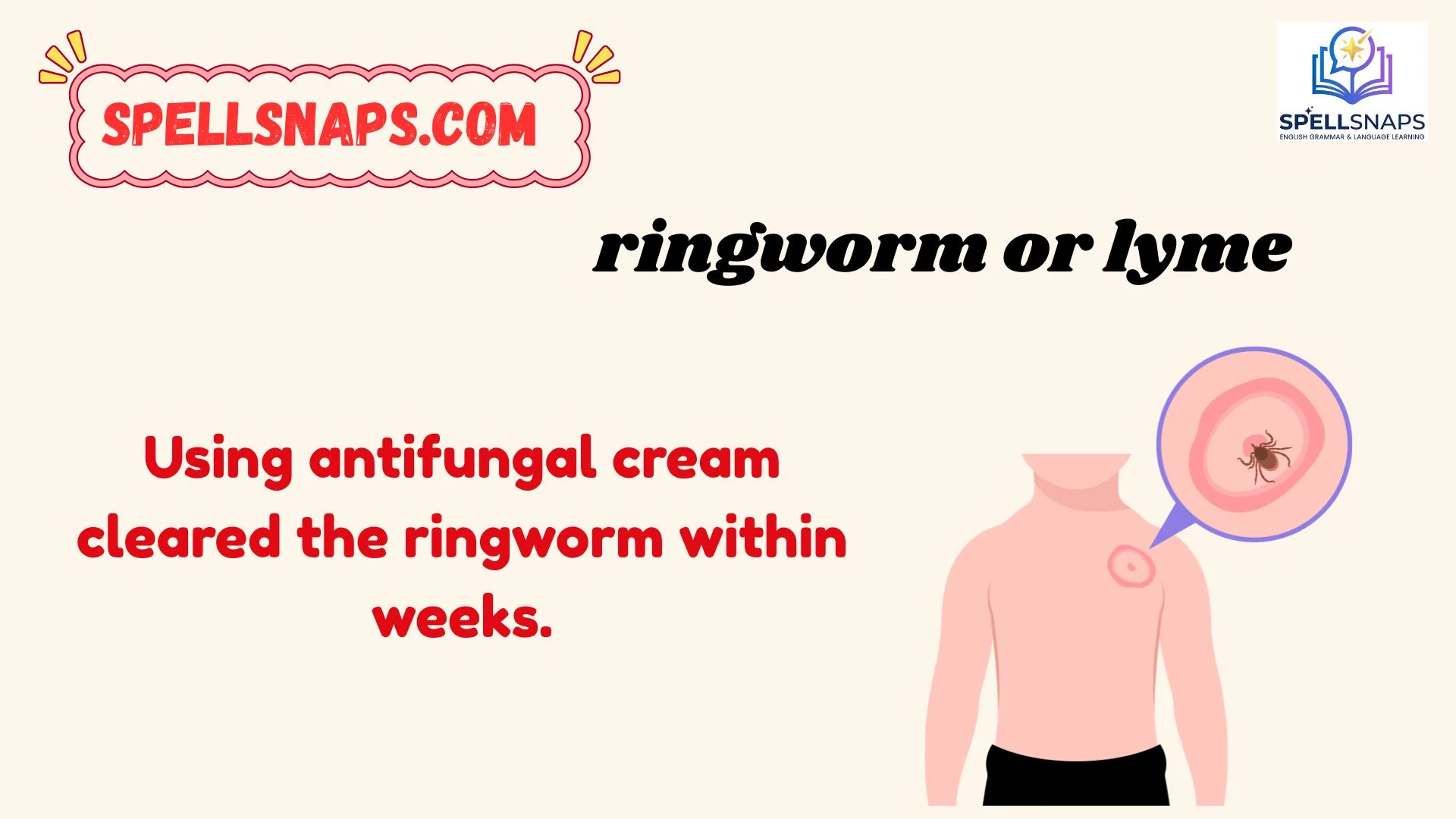
- Using antifungal cream cleared the ringworm within weeks.
Historical Note
The word ringworm has existed for centuries because early doctors believed the circular rash resembled a worm living beneath the skin. Modern medicine later proved that fungi—not worms—cause the infection.
What Is “Lyme”?
Lyme disease is a bacterial infection caused by Borrelia burgdorferi (and, in some regions, related Borrelia species). It spreads to humans through the bite of an infected black-legged tick, often called a deer tick.
When comparing ringworm or Lyme, this is the biggest distinction: Lyme disease is caused by bacteria carried by ticks—not fungi.
Common Symptoms of Lyme Disease
Early symptoms include:
- Bull’s-eye rash (erythema migrans) in many—but not all—cases
- Fever
- Chills
- Headache
- Fatigue
- Muscle aches
- Swollen lymph nodes
If untreated, Lyme disease may lead to:
- Joint pain
- Facial paralysis
- Nerve problems
- Heart rhythm issues
- Long-term neurological complications
How Lyme Disease Spreads
Unlike ringworm, Lyme disease:
- Comes from infected tick bites
- Is not contagious
- Cannot spread through touching another person
- Cannot spread by sharing towels or clothing
Examples in Sentences
- He developed Lyme disease after a hiking trip.
- The doctor ordered tests because she suspected Lyme disease.
- Removing ticks quickly helps reduce the risk of Lyme disease.
Regional Notes
Lyme disease occurs most commonly in:
- Northeastern United States
- Upper Midwest
- Parts of Canada
- Many European countries
- Some regions of Asia
The spelling Lyme always refers to the disease named after Lyme, Connecticut, where doctors first identified clusters of cases in the 1970s. There are no US vs UK spelling differences.
Key Differences Between Ringworm and Lyme
Although discussions about ringworm or Lyme often focus on skin rashes, the two conditions are entirely different.
Quick Bullet Comparison
- Ringworm is caused by fungi.
- Lyme disease is caused by bacteria.
- Ringworm spreads through direct contact.
- Lyme disease spreads through infected tick bites.
- Ringworm causes itchy, scaly rings.
- Lyme often causes a bull’s-eye rash along with flu-like symptoms.
- Antifungal medicines treat ringworm.
- Antibiotics treat Lyme disease.
- Ringworm is contagious.
- Lyme disease is not contagious between people.
Comparison Table
| Feature | Ringworm | Lyme Disease |
|---|---|---|
| Cause | Fungus | Bacteria |
| Spread | Skin contact, pets, surfaces | Tick bite |
| Contagious | Yes | No |
| Rash | Circular, itchy, scaly | Bull’s-eye pattern (often) |
| Main Treatment | Antifungal medicine | Antibiotics |
| Common Symptoms | Itching, redness | Fever, fatigue, joint pain |
| Affects | Skin, scalp, nails | Whole body |
| Prevention | Good hygiene | Tick prevention |
Real-Life Conversation Examples
Dialogue 1
Alex: I have a circular rash. Do you think it’s Lyme disease?
Taylor: Did you get bitten by a tick?
Alex: No.
Taylor: It might be ringworm instead.
🎯 Lesson: A circular rash without a tick bite may suggest ringworm, but a healthcare professional should evaluate it.
Dialogue 2
Sarah: I went hiking last weekend and now I have a bull’s-eye rash.
Mike: You should see a doctor today. That sounds like Lyme disease.
🎯 Lesson: A bull’s-eye rash after a tick bite requires prompt medical attention.
Dialogue 3
Emma: My cat has patches of missing fur.
Jack: It could be ringworm. Pets can spread it to people.
🎯 Lesson: Ringworm commonly spreads from infected animals.
Dialogue 4
Ben: Can I catch Lyme disease from my friend?
Doctor: No. Lyme disease isn’t contagious between people.
🎯 Lesson: Lyme disease spreads through tick bites, not person-to-person contact.
Dialogue 5
Lucy: My foot is itchy and peeling.
Friend: That sounds more like athlete’s foot, which is a type of ringworm.
🎯 Lesson: Ringworm includes several fungal infections affecting different body parts.
When to Use Ringworm vs Lyme
Understanding ringworm or Lyme becomes much easier when you focus on the cause and symptoms.
Use Ringworm When:
- Talking about fungal skin infections.
- Discussing contagious skin rashes.
- Referring to athlete’s foot or jock itch.
- Describing itchy, scaly circular patches.
Example
The antifungal cream treated my ringworm in two weeks.
Use Lyme When:
- Discussing tick bites.
- Talking about bacterial infections.
- Referring to hiking or wooded areas.
- Mentioning fever alongside a bull’s-eye rash.
Example
The doctor prescribed antibiotics for Lyme disease.
Easy Memory Tricks
- Ringworm = Ring-shaped fungal rash.
- Lyme = Linked to Lyme, Connecticut, and tick bites.
- Fungi need antifungals.
- Bacteria need antibiotics.
US vs UK Usage
There is no spelling difference between American and British English.
Both countries use:
- Ringworm
- Lyme disease
Medical terminology remains consistent internationally.
Fun Facts and History
1. Ringworm Isn’t a Worm 🦠
Despite the name, ringworm contains no worms at all. Scientists discovered long ago that fungi create the circular rash.
2. Lyme Disease Gets Its Name from a Town 🌲
Lyme disease is named after Lyme, Connecticut, where doctors investigated an unusual group of arthritis cases during the 1970s. That investigation led to the discovery of one of the world’s best-known tick-borne illnesses.
Common Myths About Ringworm and Lyme
Many people searching for ringworm or Lyme come across myths that can cause confusion. Let’s clear up a few of the most common ones.
Myth 1: Ringworm Is Caused by Worms
False. Ringworm is caused by fungi, not parasites or worms.
Myth 2: Every Lyme Patient Gets a Bull’s-Eye Rash
False. While many people develop the classic rash, not everyone does. Some people experience fever, fatigue, or joint pain without a noticeable rash.
Myth 3: Ringworm Always Comes from Pets
False. Pets can spread ringworm, but you can also catch it from people, contaminated surfaces, or public places like gyms and locker rooms.
Myth 4: Lyme Disease Can Spread from Person to Person
False. Lyme disease is not contagious. It spreads through the bite of an infected tick.
Prevention Tips
Preventing both conditions starts with understanding how they spread.
To Prevent Ringworm
- Wash your hands regularly.
- Keep your skin clean and dry.
- Avoid sharing towels, shoes, or clothing.
- Wear sandals in public showers.
- Check pets for signs of fungal infections.
To Prevent Lyme Disease
- Wear long sleeves while hiking.
- Use insect repellent.
- Stay on marked trails.
- Perform tick checks after spending time outdoors.
- Remove attached ticks promptly with fine-tipped tweezers.
FAQs:
Is ringworm more serious than Lyme disease?
Usually not. Ringworm is generally mild and responds well to antifungal treatment, while untreated Lyme disease can affect the joints, heart, and nervous system.
Can both conditions cause a rash?
Yes. However, ringworm usually causes an itchy, scaly ring, while Lyme disease often causes a bull’s-eye rash and flu-like symptoms.
Do both require prescription medicine?
Not always. Mild ringworm often responds to over-the-counter antifungal creams, while Lyme disease typically requires prescription antibiotics.
Can I diagnose the difference myself?
Because several skin conditions can resemble ringworm or Lyme disease, it’s best to seek medical advice if you’re unsure—especially after a tick bite or if you develop fever, expanding rashes, or worsening symptoms.
Conclusion:
Understanding the difference between ringworm or Lyme is essential because these two conditions have entirely different causes, treatments, and health risks.
\Ringworm is a contagious fungal infection that affects the skin, while Lyme disease is a bacterial illness spread by infected tick bites.
Although both may involve a rash, the appearance, symptoms, and recommended treatments are not the same.
Knowing these distinctions can help you recognize warning signs early and seek appropriate medical care.
The more familiar you are with their symptoms and prevention methods, the better prepared you’ll be to protect yourself and your family. Next time someone uses these two words, you’ll know exactly what they mean!

I am a passionate writer and content creator with a strong interest in English grammar, language learning, and effective communication. I enjoy helping readers improve their writing skills through clear, practical, and easy-to-understand content. My goal is to make grammar concepts simple and accessible for learners of all levels. Through my articles, I share useful tips, explanations, and insights that help readers gain confidence in their English language journey. I am committed to providing accurate, engaging, and valuable information that supports continuous learning and personal growth.