
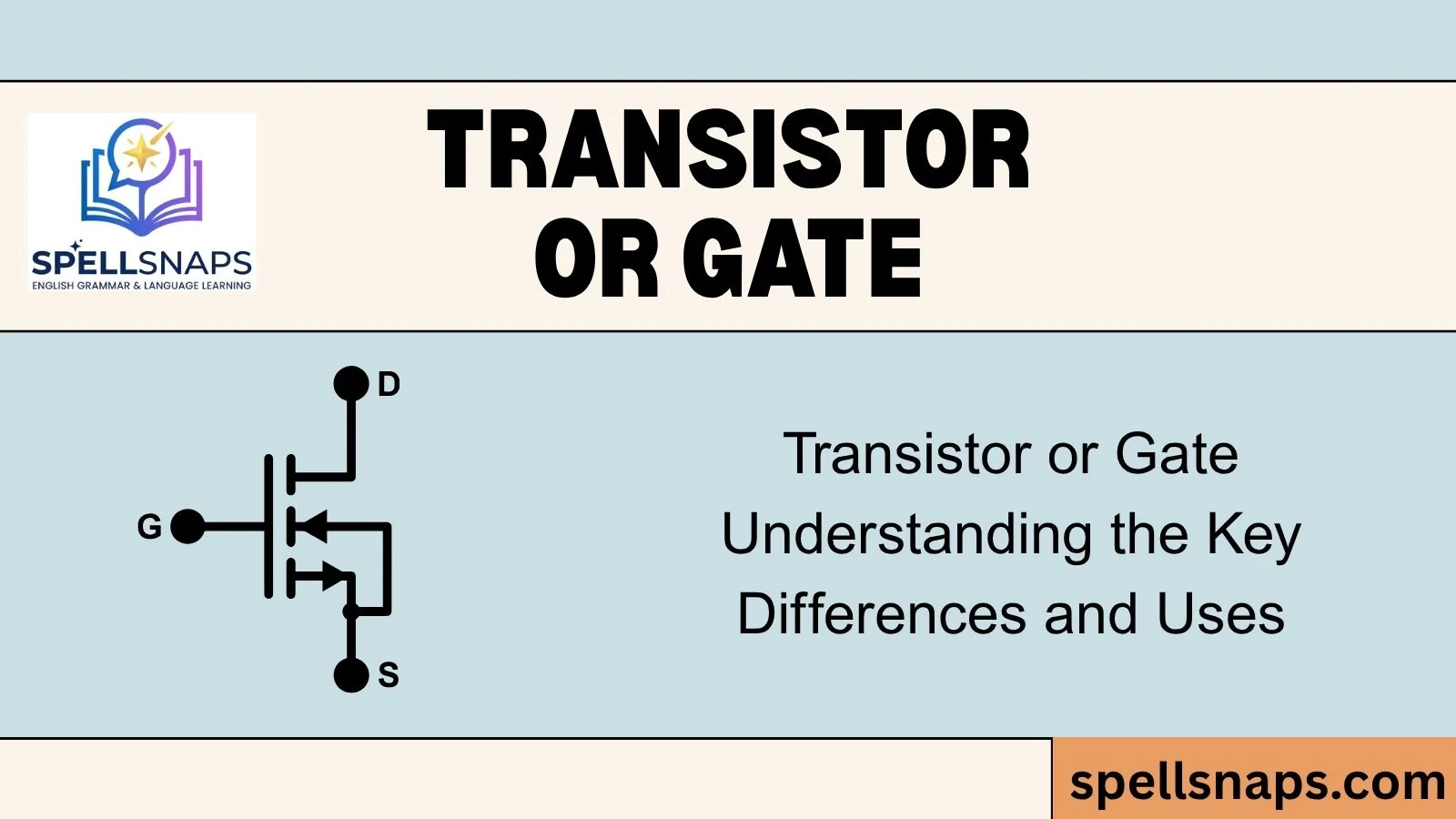
If you’ve just started learning about electronics or digital circuits, you’ve probably come across the terms transistor and gate.
At first glance, they often seem interchangeable because both play important roles in electronic devices like smartphones, computers, calculators, and even modern cars.
Many beginners assume they’re simply different names for the same thing.
Although they look/sound similar, they serve completely different purposes. A transistor is a physical electronic component that controls electrical current, while a gate (or logic gate) is a functional building block that performs logical operations using one or more transistors.
Understanding the difference between transistor or gate is essential if you’re studying electronics, computer engineering, or simply curious about how modern technology works.
This guide explains both concepts in simple English with practical examples, comparison tables, and easy memory tricks.
What Is a Transistor?
A transistor is a tiny semiconductor device that controls or amplifies electrical current. It acts like an electronic switch or amplifier, making it one of the most important inventions in modern electronics.
Whenever people compare transistor or gate, the transistor refers to the physical hardware component inside an electronic circuit.
How Is a Transistor Used?
A transistor performs several essential tasks, including:
- Turning electrical signals on and off
- Amplifying weak signals
- Switching circuits
- Controlling voltage and current
- Forming the building blocks of integrated circuits (ICs)
Billions of transistors exist inside today’s computer processors.
Where Is a Transistor Used?
You’ll find transistors in nearly every electronic device, including:
- Smartphones
- Laptops
- CPUs
- Televisions
- Radios
- Medical equipment
- Electric vehicles
- Industrial control systems
The meaning of transistor is universal across countries. There are no American or British spelling differences.
Examples in Sentences
- The engineer replaced the faulty transistor on the circuit board.
- A transistor acts like a tiny electronic switch.
- Modern processors contain billions of transistors.
- The transistor amplified the audio signal.
Brief History
The transistor was invented in 1947 at Bell Laboratories by John Bardeen, Walter Brattain, and William Shockley. It replaced bulky vacuum tubes and launched the modern electronics revolution. Without the transistor, personal computers, smartphones, and the internet would not exist as we know them today.
What Is a Gate?
A gate, more specifically a logic gate, is a digital circuit that performs logical operations on one or more input signals to produce an output.
When discussing transistor or gate, remember that a gate is not usually a single physical component. Instead, it’s a circuit made from transistors.
How Is a Gate Used?
Logic gates make decisions based on binary values:
- 0 (OFF)
- 1 (ON)
They perform operations like:
- AND
- OR
- NOT
- NAND
- NOR
- XOR
- XNOR
These operations allow computers to process information.
Where Is a Gate Used?
Logic gates are found in:
- Computer processors
- Memory chips
- Digital watches
- Calculators
- Robotics
- Automation systems
- Communication devices
- Artificial intelligence hardware
Like transistor, the word gate has the same spelling worldwide in electronics.
Examples in Sentences
- The AND gate requires both inputs to be true.
- Digital circuits contain millions of logic gates.
- The engineer simplified the design using fewer gates.
- An OR gate produces a high output if either input is high.
Short Historical Note
Logic gates became practical after the invention of the transistor. Early computers used vacuum tubes, but transistor-based gates made computers dramatically smaller, faster, cheaper, and more reliable.
Key Differences Between Transistor and Gate
Understanding transistor or gate becomes much easier once you realize that one is a physical component while the other is a logical function.
Quick Differences
- A transistor is a hardware device.
- A gate is a logical circuit.
- Several transistors combine to create one logic gate.
- Transistors control electrical current.
- Logic gates process binary information.
- Transistors are electronic switches.
- Gates perform logical decisions.
- Modern CPUs contain billions of transistors but are described as having millions or billions of logic gates depending on design.
Comparison Table
| Feature | Transistor | Gate (Logic Gate) |
|---|---|---|
| Definition | Physical semiconductor component | Digital logic circuit |
| Purpose | Controls electrical current | Performs logical operations |
| Built From | Semiconductor materials | One or more transistors |
| Function | Switches or amplifies signals | Processes binary inputs |
| Used In | Electronic circuits | Digital circuits |
| Input | Electrical signal | Binary values (0 or 1) |
| Output | Controlled electrical signal | Logical result |
| Examples | MOSFET, BJT | AND, OR, NOT, XOR |
| Physical Component? | Yes | Usually a circuit |
| Main Role | Hardware building block | Computational building block |
Real-Life Conversation Examples
Dialogue 1
Student: Is a transistor the same as a gate?
Teacher: Not exactly. A gate is built using transistors.
Student: So the transistor is the component?
Teacher: Exactly.
🎯 Lesson: A transistor is hardware, while a gate is a logical circuit.
Dialogue 2
Friend: My processor has billions of gates.
Engineer: Actually, processors contain billions of transistors that form millions or billions of logic gates.
Friend: That makes much more sense.
🎯 Lesson: Gates are created from collections of transistors.
Dialogue 3
Student: Why do we need transistors if we already have logic gates?
Professor: Because gates cannot exist without transistors.
🎯 Lesson: Transistors are the foundation of logic gates.
Dialogue 4
Technician: The transistor failed.
Customer: Does that mean the gate stopped working too?
Technician: It certainly can because damaged transistors may prevent the gate from functioning correctly.
🎯 Lesson: Hardware failures can affect logic gate operation.
Dialogue 5
Learner: Which should I study first transistor or gate?
Instructor: Learn transistors first because they explain how logic gates work.
🎯 Lesson: Understanding transistors makes digital electronics much easier.
When to Use Transistor vs Gate
Knowing when to say transistor or gate depends entirely on what you’re describing.
Use transistor when talking about:
- Semiconductor devices
- Hardware components
- Switching current
- Amplification
- Electronic repair
- Circuit design
Use gate when discussing:
- Digital electronics
- Boolean logic
- Computer architecture
- Logic circuits
- Binary operations
- Programming hardware
Simple Memory Tricks
Remember this easy rule:
- Transistor = Tiny electronic switch
- Gate = Tiny decision-maker
Another trick:
Transistors build gates. Gates build computers.
This simple sentence helps beginners remember the relationship forever.
US vs UK Usage
Unlike many English words, there are no American or British spelling differences between transistor and gate in electronics.
Both countries use the same terminology in textbooks, engineering standards, universities, and industry.
How Transistors and Gates Work Together
One reason people confuse transistor or gate is that they work so closely together.
Think of building a house:
- A brick is like a transistor.
- A wall is like a logic gate.
- A house is like a computer.
One brick cannot make a house.
Similarly, one transistor usually cannot perform complex logic by itself.
Instead:
- Multiple transistors create one logic gate.
- Multiple gates create larger circuits.
- Multiple circuits create processors.
- Processors power computers and smartphones.
This layered design is what makes modern electronics so powerful.
Common Mistakes People Make
Here are some frequent misunderstandings about transistor or gate.
Mistake 1
“A transistor is a logic gate.”
Not true.
A transistor helps build logic gates.
Mistake 2
“Every gate contains one transistor.”
Incorrect.
Most logic gates use multiple transistors depending on the technology and design.
Mistake 3
“Computers only use gates.”
Computers contain billions of physical transistors organized into countless logical structures.
Mistake 4
“Transistors only switch current.”
Besides switching, many transistors amplify electrical signals.
Fun Facts and History
💡 Fun Fact 1
A modern smartphone processor may contain tens of billions of transistors, all packed into a chip smaller than your fingernail.
💡 Fun Fact 2
The invention of the transistor is considered one of the greatest technological breakthroughs of the twentieth century and earned its inventors the 1956 Nobel Prize in Physics.
FAQs:
Is a transistor a logic gate?
No. A transistor is an electronic component, while a logic gate is a circuit made from one or more transistors.
Which came first?
The transistor came first. Logic gates became practical after engineers began building digital circuits using transistors.
Can one transistor make a computer?
No. Modern computers require billions of transistors working together.
Why are logic gates important?
Logic gates perform the calculations and decision-making processes that allow computers to execute programs.
Why should beginners learn transistors first?
Understanding transistors makes it much easier to understand logic gates, integrated circuits, and computer architecture.
Conclusion:
Understanding the difference between transistor or gate is much simpler once you know their roles. A transistor is the physical semiconductor device that controls electrical current, while a gate is a logical circuit built from one or more transistors to process binary information.
Together, they form the foundation of every modern digital device, from calculators to supercomputers.
Whether you’re studying electronics, computer science, or simply expanding your knowledge, recognizing this distinction will help you understand how technology works at its core.
Next time someone uses these two words, you’ll know exactly what they mean!

I am a passionate writer and content creator with a strong interest in English grammar, language learning, and effective communication. I enjoy helping readers improve their writing skills through clear, practical, and easy-to-understand content. My goal is to make grammar concepts simple and accessible for learners of all levels. Through my articles, I share useful tips, explanations, and insights that help readers gain confidence in their English language journey. I am committed to providing accurate, engaging, and valuable information that supports continuous learning and personal growth.