
Have you ever heard someone say they’re “getting a divorce,” while another person says they’re “filing for a dissolution”?
At first glance, these two legal terms seem to describe the same process. That is exactly why so many people use them interchangeably.
However, while they often lead to the same result the legal end of a marriage they do not always mean the same thing.
Although they look similar, they serve completely different purposes. Understanding the difference between divorce or dissolution is important whether you’re reading legal documents, researching family law, or simply trying to understand the terminology used in different countries and states.
In this guide, you’ll learn what each term means, how they’re used, where they’re commonly applied, and how to avoid confusing them. By the end, you’ll know exactly when to use each word with confidence.
What Is Divorce?
A divorce is the legal process that officially ends a valid marriage. Once a court grants a divorce, both spouses are no longer legally married and are generally free to marry someone else if they choose.
When discussing divorce or dissolution, divorce is the term most people recognize because it has been widely used in everyday language for centuries.
How Is Divorce Used?
The word divorce is commonly used in:
- Everyday conversations
- Legal proceedings
- News reports
- Family law documents
- Court decisions
It refers specifically to the legal termination of a marriage.
For example:
- They decided to file for a divorce after ten years of marriage.
- The court finalized their divorce in just six months.
- She hired an attorney to handle her divorce case.
When people search online for divorce or dissolution, they’re often looking for the legal process of ending a marriage, even if local laws technically use different terminology.
Where Is Divorce Commonly Used?
The word divorce is widely used in:
- The United States
- Canada
- The United Kingdom
- Australia
- New Zealand
- Most English-speaking countries
Although many legal systems recognize divorce, the exact legal requirements vary by jurisdiction.
For example:
- Some places require periods of separation.
- Others allow no-fault divorce.
- Certain jurisdictions require mediation before court proceedings.
Historical Note
The word divorce comes from the Latin word divortium, meaning “separation” or “turning in different directions.” Over time, it became the standard legal term describing the end of a marriage across many legal systems.
Today, when discussing divorce or dissolution, divorce remains the most familiar term worldwide.
What Is Dissolution?
Dissolution is a broader legal term that means officially ending or terminating a legal relationship, organization, or agreement. In family law, it often refers to the legal ending of a marriage or civil partnership.
Although many people think divorce or dissolution are identical, dissolution has a broader legal meaning beyond marriage.
How Is Dissolution Used?
The word dissolution appears in several legal contexts, including:
- Dissolution of marriage
- Dissolution of a civil partnership
- Dissolution of a business
- Dissolution of a company
- Dissolution of a contract
- Dissolution of a parliament
In family law, some courts deliberately use dissolution of marriage instead of divorce because the term sounds more neutral and less emotionally charged.
Examples include:
- The couple filed for a dissolution of marriage.
- The judge granted the dissolution last week.
- Their state’s laws refer to divorce as a dissolution of marriage.
When researching divorce or dissolution, it’s important to understand that one jurisdiction may prefer one term while another uses the other.
Regional and Legal Usage
In several U.S. states, such as Ohio, legal documents often use dissolution of marriage when both spouses agree on all major issues before filing.
Other states use divorce regardless of whether the spouses agree.
Outside the United States:
- Some countries primarily use divorce.
- Others use dissolution for civil partnerships.
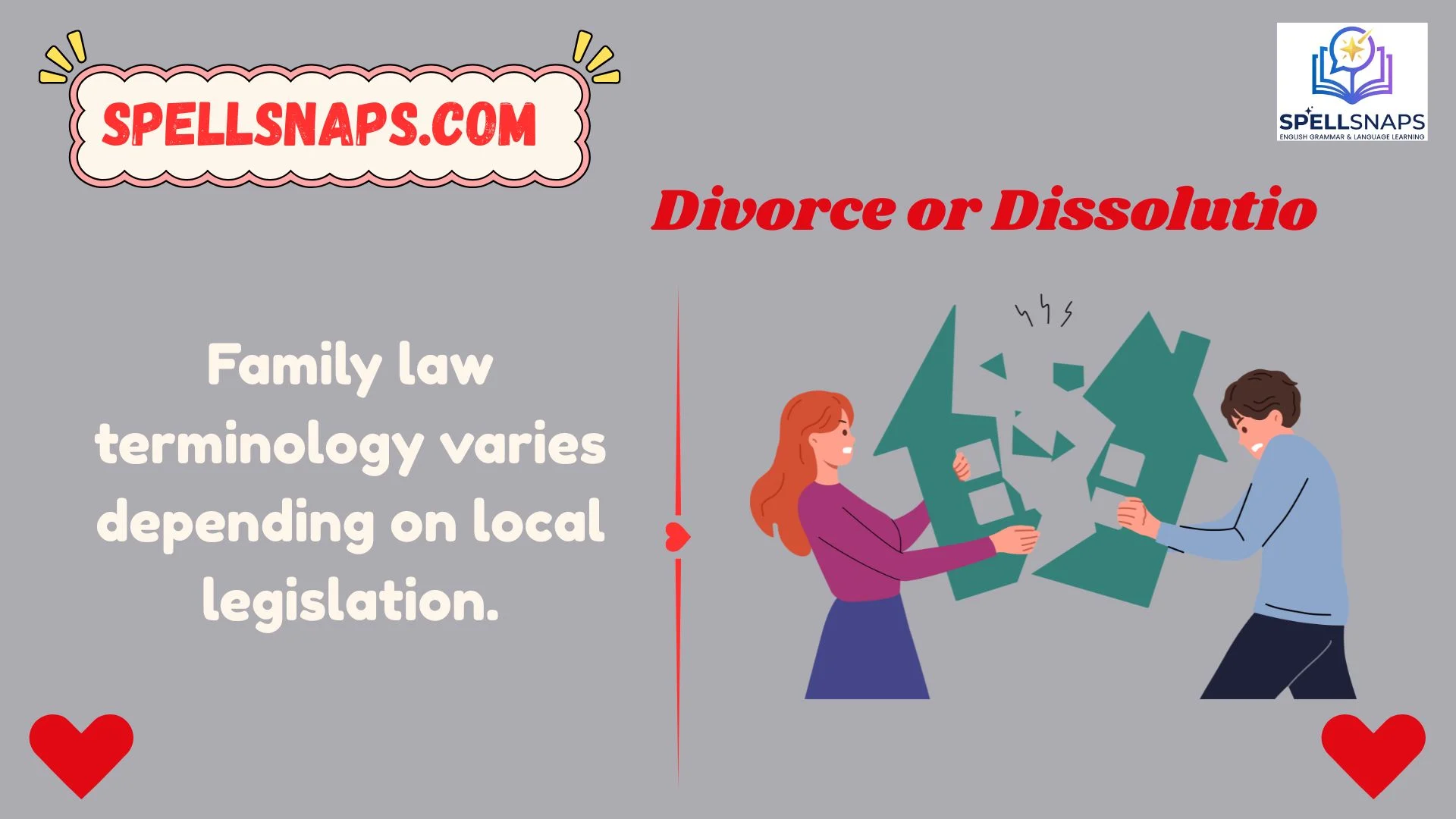
- Family law terminology varies depending on local legislation.
Historical Note
The word dissolution comes from the Latin dissolvere, meaning “to loosen apart” or “to break up.” Unlike divorce, dissolution has always been a broad legal term used in many areas of law.
Today, when comparing divorce or dissolution, dissolution often reflects the formal legal language found in statutes and court documents.
Key Differences Between Divorce and Dissolution
Although both terms can describe the legal ending of a marriage, they are not always interchangeable.
Main Differences
- Divorce specifically ends a marriage.
- Dissolution means legally ending many different legal relationships.
- Divorce is the everyday term most people understand.
- Dissolution is more common in formal legal language.
- Some courts use dissolution only when both spouses agree.
- Businesses, contracts, and organizations can also be dissolved—but never divorced.
- Local laws determine which term appears in official documents.
Comparison Table
| Feature | Divorce | Dissolution |
|---|---|---|
| Primary meaning | Legal end of a marriage | Legal termination of a legal relationship |
| Everyday use | Very common | Less common outside legal settings |
| Legal scope | Marriage only | Marriage, businesses, contracts, organizations, partnerships |
| Emotional tone | More personal | More formal and neutral |
| Used in court documents | Yes | Yes |
| Regional variation | Used worldwide | Preferred in some jurisdictions and legal systems |
| Can apply to businesses? | No | Yes |
| Can apply to marriages? | Yes | Yes |
Understanding these distinctions makes it much easier to choose the correct term when discussing divorce or dissolution.
Real-Life Conversation Examples
Dialogue 1
Emma: My cousin is getting a dissolution next month.
Ryan: Do you mean a divorce?
Emma: Actually, yes. Their state officially calls it a dissolution of marriage.
🎯 Lesson: Some legal systems use dissolution instead of divorce for the same legal outcome.
Dialogue 2
Mark: Our company is filing for divorce.
Sarah: Companies don’t get divorced—they’re dissolved.
🎯 Lesson: Dissolution applies to businesses, while divorce applies to marriages.
Dialogue 3
Lisa: I thought divorce and dissolution were exactly the same.
James: Not always. Dissolution is actually a broader legal term.
🎯 Lesson: Every divorce ends a marriage, but not every dissolution involves one.
Dialogue 4
Alex: Which word should I use in my article?
Taylor: It depends on the legal system you’re discussing.
🎯 Lesson: Always consider your audience and jurisdiction before choosing between divorce or dissolution.
Dialogue 5
Chris: Our lawyer keeps saying “dissolution.”
Jordan: That’s probably because it’s the official legal wording where you live.
🎯 Lesson: Legal professionals often use more formal terminology than everyday speakers.
When to Use Divorce vs Dissolution
Choosing between divorce or dissolution becomes much easier once you understand the context.
Use Divorce When:
- Talking in everyday conversation.
- Referring to the end of a marriage generally.
- Writing for a broad audience.
- Reading news articles or magazines.
- Discussing family relationships.
Examples:
- They got divorced last year.
- She filed for divorce.
- Their divorce was finalized quickly.
Use Dissolution When:
- Referring to formal legal documents.
- Discussing family law statutes.
- Talking about businesses or organizations ending.
- Describing civil partnerships in some jurisdictions.
- Using official court terminology.
Examples:
- The dissolution of the company was completed.
- The dissolution of marriage was approved by the court.
- The organization announced its dissolution.
Simple Memory Tricks
Here are a few easy ways to remember the difference between divorce or dissolution:
- Divorce = Marriage only.
- Dissolution = Many legal relationships.
- If it’s about a company, contract, parliament, or organization, think dissolution.
- If you’re chatting with friends about ending a marriage, divorce is almost always the natural choice.
US vs UK Usage
United States
The United States generally uses divorce, although some states officially use dissolution of marriage in statutes or for specific legal procedures.
United Kingdom
The United Kingdom primarily uses divorce for ending marriages. However, dissolution is commonly used for ending civil partnerships and in other legal contexts.
Other English-Speaking Countries
Countries such as Canada, Australia, and New Zealand also primarily use divorce, while dissolution appears in formal legal language depending on local legislation.
When writing about divorce or dissolution, always check the terminology used by the relevant legal jurisdiction.
FAQs:
1. Divorce Is One of the Oldest Legal Concepts
Ancient civilizations, including the Romans and Babylonians, had legal systems that recognized various forms of marital separation long before modern courts existed.
2. Dissolution Isn’t Limited to Marriage
One of the most interesting facts about dissolution is its versatility. Governments dissolve parliaments, businesses dissolve companies, courts dissolve partnerships, and organizations dissolve committees. That broad legal application is what separates it from divorce, which is reserved for ending marriages.
Conclusion:
Understanding the difference between divorce or dissolution helps you communicate more accurately, especially when discussing legal matters.
While divorce is the familiar term used to describe the legal end of a marriage, dissolution is a broader legal concept that can apply to marriages, businesses, partnerships, contracts, and other legal relationships.
The correct choice often depends on the legal system, jurisdiction, and context in which you’re writing or speaking.
Knowing these distinctions makes legal terminology much less confusing and helps you use each word with confidence. Next time someone uses these two words, you’ll know exactly what they mean!

I am a passionate writer and content creator with a strong interest in English grammar, language learning, and effective communication. I enjoy helping readers improve their writing skills through clear, practical, and easy-to-understand content. My goal is to make grammar concepts simple and accessible for learners of all levels. Through my articles, I share useful tips, explanations, and insights that help readers gain confidence in their English language journey. I am committed to providing accurate, engaging, and valuable information that supports continuous learning and personal growth.