
Have you ever heard someone say “janitor” while another person says “custodian” and wondered if they mean the same job? You’re not alone.
These two words are often used interchangeably because both describe people who help keep buildings clean, safe, and functional.
However, the terms can carry different meanings depending on the workplace, region, and level of responsibility.
Although they look/sound similar, they serve completely different purposes.
Understanding the difference between janitor or custodian is important whether you’re writing a job description, applying for work, speaking professionally, or simply trying to use the correct term.
In this guide, you’ll learn what each word means, how they’re used, where they’re most common, and which one fits different situations. By the end, you’ll confidently know when to say janitor and when custodian is the better choice.
What Is Janitor?
A janitor is a person responsible for cleaning, maintaining, and performing basic repairs in buildings such as schools, offices, hospitals, apartment complexes, shopping centers, and factories.
The primary role of a janitor focuses on cleanliness and daily maintenance. Their work helps ensure that buildings remain safe, hygienic, and comfortable for everyone.
Common Responsibilities of a Janitor
A janitor may:
- Sweep, mop, and vacuum floors
- Empty trash bins
- Clean restrooms
- Dust furniture and surfaces
- Refill soap and paper products
- Wash windows
- Perform small maintenance tasks
- Report repair issues
Although cleaning is the main responsibility, many janitors also assist with light maintenance, especially in smaller buildings.
Example Sentences
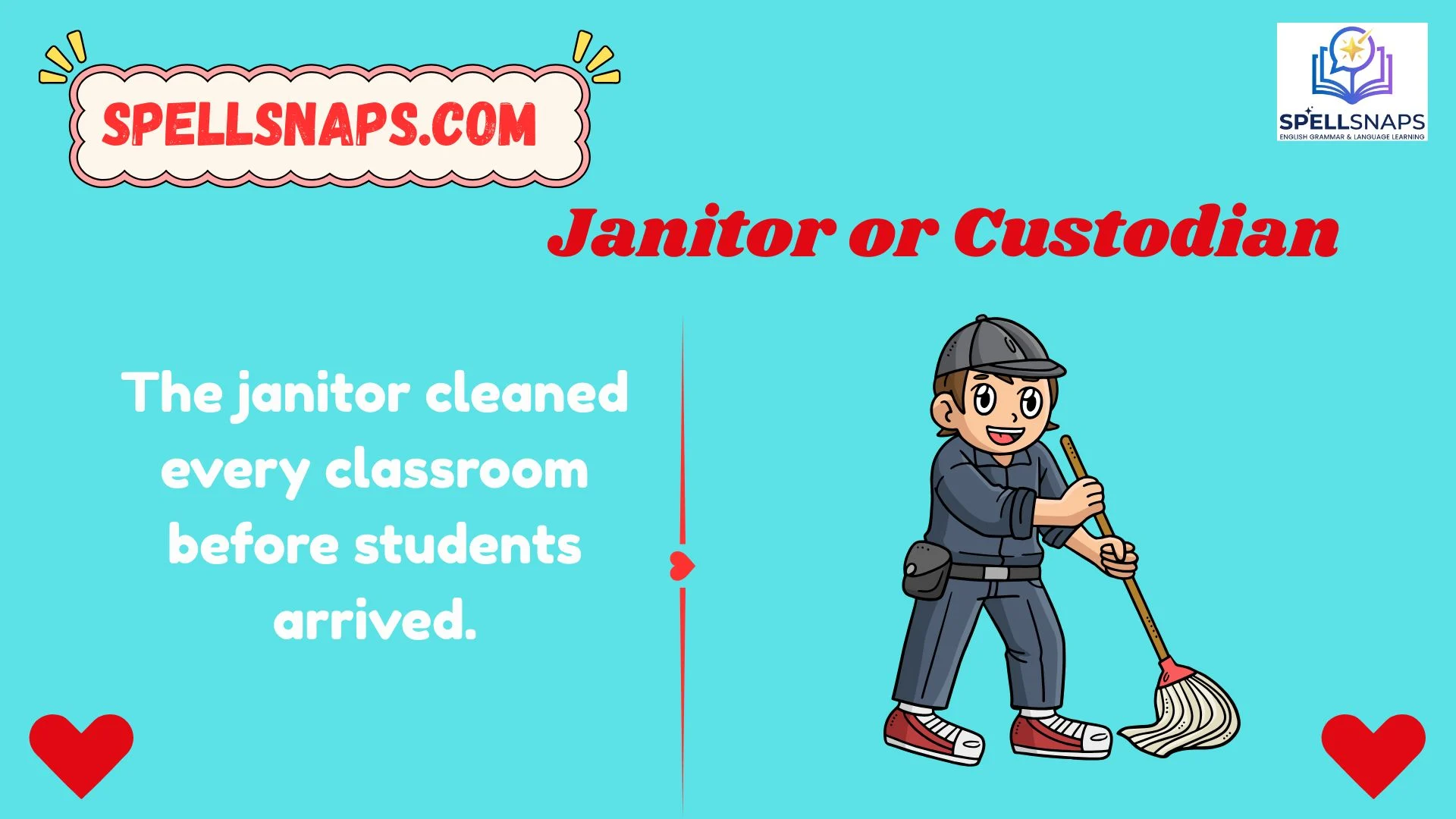
- The janitor cleaned every classroom before students arrived.
- Our office janitor empties the trash every evening.
- The shopping mall hired a new janitor to maintain the food court.
Where Is “Janitor” Commonly Used?
The word janitor is widely used in:
- United States
- Canada
- Some other English-speaking countries
However, many organizations today prefer the word custodian because it sounds more professional and reflects a broader range of duties.
Historical Background
The word janitor comes from the Latin word janua, meaning door. In ancient times, a janitor was literally a gatekeeper or doorkeeper responsible for watching entrances. Over time, the meaning expanded to include building care and maintenance.
Today, janitor usually emphasizes hands-on cleaning and routine building upkeep.
What Is Custodian?
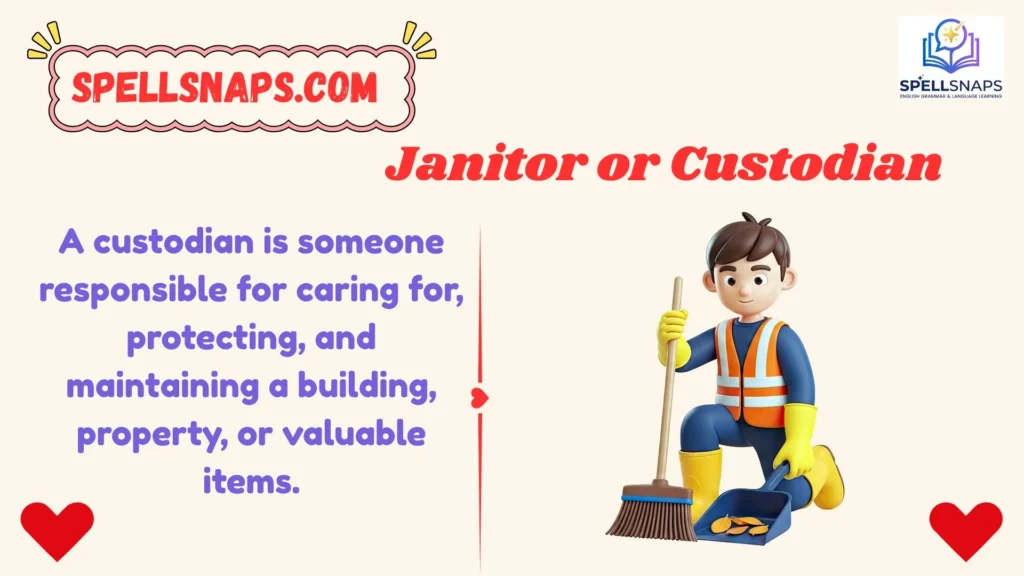
A custodian is someone responsible for caring for, protecting, and maintaining a building, property, or valuable items. In many workplaces, a custodian performs cleaning duties similar to a janitor but often has broader responsibilities.
Many schools, universities, government buildings, and large organizations prefer using the title custodian because it highlights responsibility rather than simply cleaning.
Common Responsibilities of a Custodian
A custodian may:
- Clean buildings
- Inspect facilities
- Handle maintenance requests
- Secure the building
- Unlock and lock doors
- Prepare rooms for meetings
- Monitor building safety
- Coordinate repairs
- Manage maintenance supplies
In many organizations, custodians work closely with maintenance teams to keep facilities operating efficiently.
Example Sentences
- The school custodian opened the gym before the basketball game.
- Please report the broken window to the custodian.
- Every evening, the custodian checks that all doors are locked.
Where Is “Custodian” Commonly Used?
The word custodian is especially common in:
- Schools
- Colleges
- Universities
- Government facilities
- Public institutions
- Large office buildings
In modern American English, custodian is often considered a more respectful and professional job title than janitor, although both remain correct.
Historical Background
The word custodian comes from the Latin word custodia, meaning guardianship or protection.
Originally, a custodian was someone who protected valuable property or important records. Today, the term still reflects the idea of caring for and protecting a place rather than simply cleaning it.
Key Differences Between Janitor and Custodian
Although people often use janitor or custodian interchangeably, subtle differences exist.
Quick Bullet Comparison
- Janitor usually emphasizes cleaning duties.
- Custodian often includes cleaning plus building care.
- Custodian sounds more professional in many workplaces.
- Schools frequently use custodian instead of janitor.
- Both jobs help maintain clean and safe environments.
- Job responsibilities may overlap depending on the employer.
- The difference is often based on job title rather than actual tasks.
Comparison Table
| Feature | Janitor | Custodian |
|---|---|---|
| Primary focus | Cleaning | Building care and maintenance |
| Daily duties | Cleaning, trash removal, basic repairs | Cleaning, inspections, security, maintenance coordination |
| Professional tone | Traditional | More formal and respectful |
| Common workplaces | Offices, malls, apartments | Schools, colleges, government buildings |
| Scope of responsibility | Usually narrower | Usually broader |
| Modern preference | Still common | Increasingly preferred |
| Meaning | Cleaner and maintenance worker | Caretaker of facilities |
Real-Life Conversation Examples
Dialogue 1
Emma: Is the janitor coming today?
Jake: Our school calls him the custodian now.
Emma: Oh, does he still clean the classrooms?
Jake: Yes, but he also handles building maintenance.
🎯 Lesson: A custodian often has more responsibilities than a traditional janitor.
Dialogue 2
Sarah: Who should I call about the broken classroom projector?
Teacher: Ask the custodian.
Sarah: I thought custodians only cleaned.
Teacher: They also help manage the building.
🎯 Lesson: Custodians often coordinate repairs and building operations.
Dialogue 3
David: The office hired a new janitor.
Lisa: I noticed their business cards say Facility Custodian.
David: So it’s basically the same job?
Lisa: Mostly, but the title reflects broader responsibilities.
🎯 Lesson: Different employers choose different job titles for similar work.
Dialogue 4
Mark: Why doesn’t our university use the word janitor?
Professor: They prefer custodian because it better represents the position.
🎯 Lesson: Many organizations choose custodian as a more professional title.
Dialogue 5
Anna: Who locks the building every night?
Ben: The custodian does after finishing the cleaning.
🎯 Lesson: Custodians often handle both cleaning and security duties.
When to Use Janitor vs Custodian
Choosing between janitor or custodian depends on your audience, workplace, and level of formality.
Use Janitor When
- Referring mainly to cleaning duties.
- Describing traditional maintenance work.
- Talking about smaller buildings or businesses.
- Using everyday informal conversation.
Example
“Our office janitor arrives every evening.”
Use Custodian When
- Writing professional documents.
- Describing school employees.
- Referring to someone responsible for an entire facility.
- Writing job advertisements.
- Using respectful workplace language.
Example
“The school custodian prepared the auditorium for graduation.”
Simple Memory Tricks
Remember This:
Janitor = Job focused on cleaning.
Think:
J = Janitor = Jobs involving daily cleaning.
Custodian = Caretaker of the building.
Think:
C = Custodian = Cares for the complete facility.
This simple trick helps you quickly decide which word fits your sentence.
US vs UK Usage
Unlike spelling differences such as color/colour, there is no major US vs UK rule separating janitor and custodian.
However:
United States
- Both words are common.
- Schools increasingly use custodian.
- Businesses often choose custodian in official job titles.
United Kingdom
The word caretaker is often more common than either janitor or custodian, especially in schools and public buildings. However, British readers still understand both terms.
When writing for an international audience, always choose the title preferred by the organization or employer you’re referring to.
Fun Facts and History
1. Many Schools Changed Job Titles
Over the last few decades, thousands of schools changed employee titles from janitor to custodian. The goal was to recognize that these professionals do much more than clean—they help manage facilities, maintain safety, and support daily operations.
2. Custodians Keep Buildings Running
Many custodians know basic plumbing, electrical troubleshooting, HVAC monitoring, and emergency procedures. Their work often prevents small problems from becoming expensive repairs.
Without custodians, schools, hospitals, and offices would struggle to operate smoothly.
FAQs:
Is a janitor the same as a custodian?
Not exactly. A janitor usually focuses on cleaning and routine upkeep, while a custodian often has additional responsibilities such as building maintenance, security checks, and facility management. In many workplaces, though, the same person may perform both roles.
Which term is more respectful?
Many employers prefer custodian because it reflects a broader scope of responsibility and is viewed as a more professional title. However, janitor is still a correct and widely accepted word.
Can a custodian perform janitorial work?
Yes. Most custodians regularly clean buildings while also handling maintenance, inspections, and other facility-related tasks.
Why do schools usually use “custodian”?
Schools often choose custodian because the role goes beyond cleaning. Custodians may prepare classrooms, oversee building safety, coordinate repairs, and support school events.
Should I use “janitor” or “custodian” on a resume?
Use the job title that matches your official position. If your duties included maintenance, security, and facility management, custodian may better reflect your experience.
Conclusion
Understanding the difference between janitor or custodian helps you communicate more accurately and professionally.
While both roles involve keeping buildings clean and functional, a janitor generally focuses on cleaning and routine maintenance, whereas a custodian often takes on broader responsibilities that include building care, safety, and facility management.
In many workplaces, the duties overlap, but the job title can reflect different expectations and levels of responsibility.
By choosing the appropriate term for your audience and context, you’ll sound more precise and informed. Next time someone uses these two words, you’ll know exactly what they mean!

I am a passionate writer and content creator with a strong interest in English grammar, language learning, and effective communication. I enjoy helping readers improve their writing skills through clear, practical, and easy-to-understand content. My goal is to make grammar concepts simple and accessible for learners of all levels. Through my articles, I share useful tips, explanations, and insights that help readers gain confidence in their English language journey. I am committed to providing accurate, engaging, and valuable information that supports continuous learning and personal growth.