
Dinosaurs have fascinated people for generations, and few names are as recognizable as Brachiosaurus and Brontosaurus.
Whether you’re reading a science book, watching a dinosaur documentary, or enjoying a movie, you’ve probably heard both names.
Because these giant plant-eaters lived millions of years ago and shared several physical features, many people assume they refer to the same dinosaur.
Although they look/sound similar, they serve completely different purposes.
In reality, Brachiosaurus or Brontosaurus is a comparison between two different dinosaur genera with unique body structures, histories, and scientific backgrounds.
Understanding their differences not only improves your dinosaur knowledge but also helps you use each name correctly in conversations, school assignments, and educational content.
This guide explains everything in simple English so you’ll never confuse these prehistoric giants again.
What Is “Brachiosaurus”?
Brachiosaurus is a giant, long-necked herbivorous dinosaur that lived during the Late Jurassic Period, approximately 154–150 million years ago. Its name comes from Greek words meaning “arm lizard,” referring to its unusually long front legs.
Unlike many other long-necked dinosaurs, Brachiosaurus had front legs that were longer than its hind legs. This gave its back a noticeable upward slope and allowed it to reach the tops of tall trees for food.
Scientists believe Brachiosaurus could grow around 70–85 feet (21–26 meters) long and weigh up to 50 tons, making it one of the largest land animals ever discovered.
How Is Brachiosaurus Used?
The word Brachiosaurus is mainly used in:
- Scientific research
- Museums
- Educational books
- Documentaries
- Dinosaur discussions
- Children’s learning materials
It refers only to this specific dinosaur genus.
Examples in Sentences
- Brachiosaurus used its long neck to eat leaves high above the ground.
- The museum displayed a life-sized Brachiosaurus skeleton.
- Many children recognize Brachiosaurus from dinosaur documentaries.
- Scientists continue studying Brachiosaurus fossils to understand Jurassic ecosystems.
Historical Note
American paleontologist Elmer Riggs officially described Brachiosaurus in 1903 after fossils were discovered in Colorado, USA. Since then, it has become one of the most famous dinosaurs ever identified.
What Is “Brontosaurus”?
Brontosaurus is another giant, long-necked herbivorous dinosaur from the Late Jurassic Period. Its name means “thunder lizard,” reflecting its enormous size.
For decades, scientists debated whether Brontosaurus was actually a separate dinosaur or simply another species of Apatosaurus. In 1903, researchers concluded that the fossils belonged to Apatosaurus, causing the name Brontosaurus to disappear from scientific use for over a century.
However, a detailed scientific study published in 2015 suggested that Brontosaurus has enough unique characteristics to be considered its own genus again. While not every paleontologist agrees, many now recognize Brontosaurus as valid.
How Is Brontosaurus Used?
Today, Brontosaurus appears in:
- Popular culture
- Dinosaur books
- Museums
- Educational resources
- Movies
- Children’s cartoons
It specifically refers to this dinosaur genus rather than serving as another name for Brachiosaurus.
Examples in Sentences
- My favorite dinosaur has always been Brontosaurus.
- The documentary explained why Brontosaurus returned to scientific discussions.
- Children often mistake Brontosaurus for Brachiosaurus.
- The museum featured a model of Brontosaurus beside several other sauropods.
Historical Note
Paleontologist Othniel Charles Marsh first named Brontosaurus in 1879. Although the name temporarily disappeared from scientific classification, it remained extremely popular with the public.
Key Differences Between Brachiosaurus and Brontosaurus
Although Brachiosaurus or Brontosaurus often appear together, they are not the same dinosaur.
Main Differences
- Brachiosaurus had longer front legs than back legs.
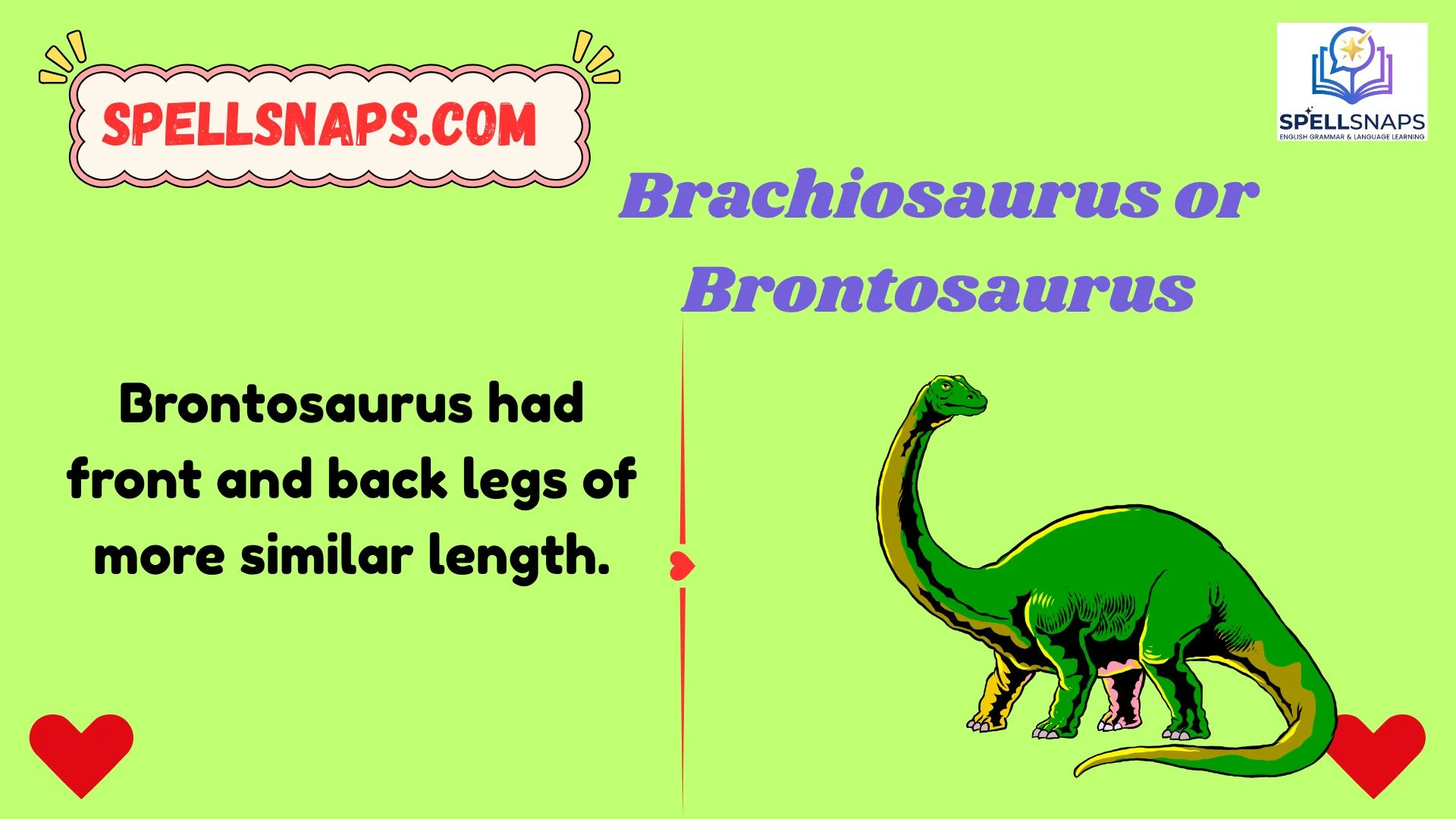
- Brontosaurus had front and back legs of more similar length.
- Brachiosaurus stood with a higher shoulder position.
- Brontosaurus had a longer, more horizontal body posture.
- Brachiosaurus reached taller trees for food.
- Brontosaurus likely fed at lower heights compared with Brachiosaurus.
- Their skulls, neck proportions, and body structures differ.
- They belong to different dinosaur genera.
Comparison Table
| Feature | Brachiosaurus | Brontosaurus |
|---|---|---|
| Meaning of Name | Arm Lizard | Thunder Lizard |
| Named In | 1903 | 1879 |
| Front Legs | Longer than hind legs | Similar length to hind legs |
| Body Shape | Sloping upward | More level body |
| Feeding Height | Very tall trees | Lower vegetation and mid-level trees |
| Scientific Status | Widely accepted | Reinstated by many scientists in 2015 |
| Famous For | Tall browsing posture | Long scientific naming debate |
| Dinosaur Family | Brachiosauridae | Diplodocidae |
Real-Life Conversation Examples
Dialogue 1
Emma: Is Brontosaurus the same dinosaur as Brachiosaurus?
Jake: No. They’re different dinosaurs with different body shapes.
🎯 Lesson: Similar appearance doesn’t mean they’re the same species.
Dialogue 2
Teacher: Which dinosaur had longer front legs?
Student: That’s Brachiosaurus, not Brontosaurus.
🎯 Lesson: Longer front legs are one of Brachiosaurus’ defining features.
Dialogue 3
Child: I thought Brontosaurus wasn’t real.
Parent: Scientists now recognize it again after newer research.
🎯 Lesson: Scientific classifications can change when new evidence appears.
Dialogue 4
Tour Guide: Which dinosaur reached the highest tree branches?
Visitor: Brachiosaurus because of its tall shoulders and neck.
🎯 Lesson: Body structure influenced how dinosaurs found food.
Dialogue 5
Friend: Why do people confuse Brachiosaurus or Brontosaurus?
Friend 2: Because both are giant long-necked plant-eaters from the Jurassic Period.
🎯 Lesson: Their similarities often cause understandable confusion.
When to Use Brachiosaurus vs Brontosaurus
Using Brachiosaurus or Brontosaurus correctly becomes easy once you remember what each dinosaur represents.
Use Brachiosaurus when:
- Talking about the dinosaur with long front legs.
- Discussing high-feeding sauropods.
- Referring to fossils identified as Brachiosaurus.
- Writing scientific or educational content about its unique anatomy.
Use Brontosaurus when:
- Referring to the dinosaur called the “Thunder Lizard.”
- Discussing its historical naming controversy.
- Talking about popular dinosaur culture.
- Mentioning the dinosaur recognized again by many scientists.
Simple Memory Tricks
- Brachiosaurus = Big arms (front legs).
- Brontosaurus = Thunder Lizard.
- High browser = Brachiosaurus.
- Naming debate = Brontosaurus.
US vs UK Usage
Unlike spelling differences such as color/colour, there is no US or UK variation between Brachiosaurus and Brontosaurus. Both names are used worldwide in English-speaking countries according to scientific classification.
Fun Facts and History
🦕 1. Brachiosaurus Was One of the Tallest Dinosaurs
Because of its unusually long front legs and neck, Brachiosaurus could browse vegetation over 40 feet (12 meters) above the ground, reaching leaves unavailable to many other herbivores.
🌿 2. Brontosaurus Made a Scientific Comeback
For more than 100 years, many textbooks replaced Brontosaurus with Apatosaurus. Then, in 2015, new fossil analysis suggested Brontosaurus deserved recognition as its own separate genus again, sparking excitement among dinosaur enthusiasts worldwide.
FAQs:
Is Brontosaurus the same as Brachiosaurus?
No. They are different dinosaur genera with distinct skeletal structures, body proportions, and evolutionary relationships.
Which dinosaur was bigger?
Both were enormous. Brachiosaurus was generally taller because of its longer front legs, while Brontosaurus was long and heavily built.
Why do people confuse Brachiosaurus and Brontosaurus?
Both were gigantic, long-necked, plant-eating dinosaurs that lived during the Jurassic Period. Their overall appearance makes them easy to mix up.
Is Brontosaurus officially recognized?
Many paleontologists now recognize Brontosaurus as a valid genus following a major 2015 scientific study, although some researchers continue to debate its classification.
Which dinosaur appeared in Jurassic Park?
The towering long-necked dinosaur introduced early in the original film is generally portrayed as Brachiosaurus.
Conclusion:
Understanding Brachiosaurus or Brontosaurus is much easier once you know what makes each dinosaur unique.
Brachiosaurus stood taller with longer front legs and specialized in reaching high vegetation, while Brontosaurus became famous for its fascinating scientific naming history and its powerful “Thunder Lizard” identity.
Although both were enormous Jurassic herbivores, they belonged to different dinosaur groups and possessed distinct anatomical features.
Whether you’re writing an assignment, visiting a museum, or simply talking with fellow dinosaur fans, using the correct name shows a better understanding of prehistoric life. Next time someone uses these two words, you’ll know exactly what they mean!

I am a passionate writer and content creator with a strong interest in English grammar, language learning, and effective communication. I enjoy helping readers improve their writing skills through clear, practical, and easy-to-understand content. My goal is to make grammar concepts simple and accessible for learners of all levels. Through my articles, I share useful tips, explanations, and insights that help readers gain confidence in their English language journey. I am committed to providing accurate, engaging, and valuable information that supports continuous learning and personal growth.